Modern sex doll heads can differ in much more than facial appearance. The head material, mouth construction, jaw mechanism, oral channel, hair implantation, and optional functional systems can all affect how a head looks, feels, operates, and needs to be maintained.
In the manufacturer demonstration reviewed by XLifeDoll, three configurations are compared:
- ROS head
- Hard silicone head
- TPE head
They are not simply three versions of the same design. Each configuration combines different materials and functional architecture.
Understanding those differences is especially important if you are comparing features such as a movable jaw, oral function, deeper oral channel, implanted hair, oral heating, or auto-suction.
Quick Answer
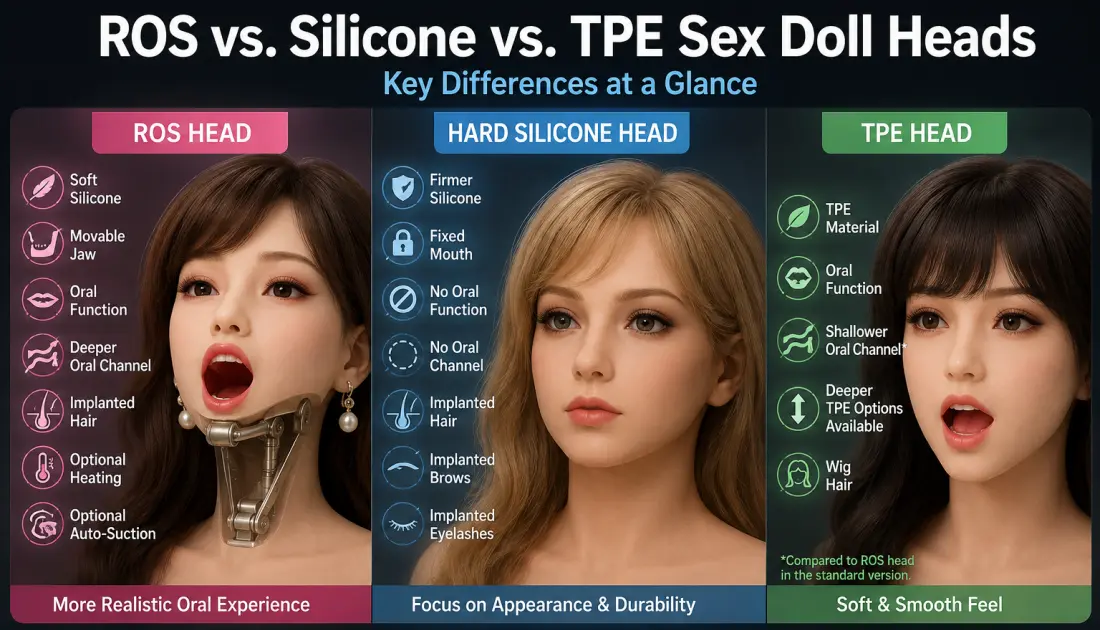
An ROS head in the demonstrated product line uses soft silicone, includes an openable mouth with a movable jaw, supports oral functionality, and can be configured with optional oral heating and auto-suction.
The hard silicone head shown in the demonstration uses a firmer silicone feel and supports implanted hair, eyebrows, and eyelashes, but the demonstrated version has a fixed mouth and no oral function.
The TPE head uses TPE material and is available with oral functionality. In the standard configuration shown in the video, its oral channel is shallower than the ROS version, although deeper TPE configurations are also available.
The important distinction is:
Head material and oral-system design are separate product attributes.
A silicone head does not automatically mean ROS, and an oral-capable mouth does not automatically mean a movable jaw.
On This Page
- ROS, Hard Silicone, and TPE Heads at a Glance
- What Is an ROS Head?
- What Is a Hard Silicone Head?
- What Is a TPE Head?
- Movable Jaw vs. Open Mouth
- How Oral Channel Design Differs
- Hair, Eyebrow, and Eyelash Implantation
- Oral Heating and Auto-Suction
- Cleaning and Drying Differences
- Lubricant Compatibility
- Which Head Type Is Right for You?
- What We Still Do Not Know
- How to Compare a Sex Doll Head Before Buying
- Frequently Asked Question
ROS, Hard Silicone, and TPE Sex Doll Heads at a Glance
The following comparison reflects the configurations demonstrated in the supplied manufacturer video. It should not be interpreted as a universal specification for every head produced by every factory.
| Feature | ROS Head | Hard Silicone Head | TPE Head |
|---|---|---|---|
| Main material | Soft silicone | Firmer silicone | TPE |
| Relative feel | Softer | Firmer than ROS | Soft and smooth |
| Implanted hair | Supported | Supported | Not confirmed by this video |
| Implanted eyebrows | Supported | Supported | Not confirmed |
| Implanted eyelashes | Supported | Supported | Not confirmed |
| Movable jaw | Yes | No in shown configuration | Not established by video |
| Oral function | Yes | No in shown configuration | Yes |
| Oral channel | Deeper reference system in comparison | None in shown configuration | Shallower in standard shown version |
| Deep-throat option | ROS oral system | N/A in shown configuration | Available on some TPE versions |
| Oral heating | Optional | Not shown | Not shown |
| Auto-suction | Optional | Not shown | Not shown |
| Internal oral cleaning | Required | Not applicable to shown non-oral version | Required when oral channel is present |
| Internal drying | Required | Not applicable to shown non-oral version | Required when oral channel is present |
| Lubricant | Product/system compatibility must be verified | N/A for oral use in shown version | Product/system compatibility must be verified |
This table also illustrates why phrases such as “silicone head” or “TPE head” do not fully describe the product.
What Is an ROS Head?
In the supplied manufacturer demonstration, ROS is described as a:
Real Oral Sex Head
within that particular product line.
XLifeDoll does not treat this as a universal industry-wide definition of the acronym. It is the terminology used in the demonstrated manufacturer system.
The ROS version shown uses soft silicone and combines several functional features within one head architecture.
The demonstrated ROS configuration includes:
- soft silicone exterior;
- implanted-hair support;
- implanted eyelashes;
- implanted eyebrows;
- openable mouth;
- movable jaw;
- internal oral function.
Optional features shown in the video include:
- oral heating
- oral auto-suction
This makes ROS more than a material choice.
A better way to understand it is:
ROS = material + jaw architecture + internal oral system + optional functional upgrades.
That distinction matters because another silicone head may use the same broad material category without including the same mouth mechanism or internal system.
What Is a Hard Silicone Head?
The second configuration in the video is a hard silicone head.
“Hard” here should be understood as a relative comparison with the softer ROS head, not as a universal hardness specification.
No Shore hardness value or manufacturer-certified numerical hardness was provided in the video, so the article should not invent one.
The demonstrated hard silicone head supports:
- hair implantation;
- eyebrow implantation;
- eyelash implantation.
Its key functional difference in the video is the mouth.
The demonstrated configuration has:
a fixed mouth that does not open and therefore does not include oral functionality.
This statement must remain configuration-specific.
It would be inaccurate to conclude:
“All hard silicone heads have no oral function.”
The video establishes only that the hard silicone configuration being demonstrated does not include it.
For buyers, this makes the shown hard silicone version more focused on:
- facial appearance;
- firmer structural feel;
- implanted cosmetic details;
rather than an internal oral-function system.
What Is a TPE Head?
The third configuration uses TPE, or thermoplastic elastomer.
The video describes the TPE head as having a soft and smooth feel and shows a version with an oral function.
Unlike the ROS head, however, the standard TPE configuration in the comparison uses a shallower oral channel.
The video also makes an important clarification:
Deeper TPE oral configurations are available.
Therefore, the correct conclusion is not:
“TPE heads have shallow mouths.”
It is:
The standard TPE version shown has a shallower oral channel than the demonstrated ROS head, while some TPE configurations are available with deeper oral architecture.
The manufacturer video also indicates that TPE heads commonly use wigs rather than establishing the same implanted-hair claims made for the ROS and hard silicone heads.
For that reason, XLifeDoll does not automatically mark implanted hair, eyebrows, or eyelashes as standard TPE-head features unless the individual product specification confirms them.
Movable Jaw vs. Open Mouth: What’s the Difference?
This is one of the most important distinctions in the entire comparison.
A mouth can fall into several different functional categories.
Fixed Mouth
The mouth shape is essentially fixed.
The hard silicone configuration shown in the video falls into this category.
Openable or Oral-Capable Mouth
The head contains a mouth opening and oral channel.
This does not automatically mean it has a mechanically articulated jaw.
A TPE oral head, for example, may support oral functionality without using the same movable-jaw architecture demonstrated by ROS.
Movable Jaw
A movable jaw uses a mechanical jaw structure that allows the lower jaw to change position rather than relying solely on the flexibility of the surrounding material.
The ROS head demonstrated in the video includes this feature.
Therefore:
Openable mouth ≠ movable jaw.
This distinction should also be preserved on product pages.
If a product can open its mouth but does not use a mechanical movable-jaw system, it should not be advertised as having movable-jaw technology.
How Does Oral Channel Design Differ?
The manufacturer video identifies a meaningful difference between the ROS and standard TPE configurations.
ROS
The ROS version serves as the deeper oral reference system in the demonstration.
Standard TPE Version
The demonstrated standard TPE oral channel is described as shallower.
Deeper TPE Version
The video also confirms that deeper TPE variants exist.
What the evidence does not provide is an exact measurement.
Therefore XLifeDoll does not publish invented values such as:
- 10 cm;
- 12 cm;
- 15 cm;
- or any other oral depth
unless the factory verifies the specification for the actual head model.
The correct comparison is structural rather than numerical:
ROS: deeper oral-system configuration in the demonstration
Standard TPE: shallower configuration in the demonstration
Some TPE versions: deeper oral channel available
Hair, Eyebrow, and Eyelash Implantation
The video clearly distinguishes the ROS and hard silicone heads from the TPE example in this area.
ROS Head
Supports:
- implanted hair;
- implanted eyelashes;
- implanted eyebrows.
Hard Silicone Head
Also supports:
- implanted hair;
- implanted eyelashes;
- implanted eyebrows.
TPE Head
The video describes the TPE configuration as typically using a wig.
It does not explicitly establish implanted-hair, eyebrow, or eyelash support for the TPE configuration shown.
Therefore, those features should remain:
product-specific / not confirmed by this video
rather than being filled into a comparison table simply for symmetry.
Oral Heating and Auto-Suction
The ROS demonstration shows two optional upgrades:
Oral Heating
The video indicates that oral heating can be added.
This wording matters.
It means:
optional feature
not:
standard ROS equipment
The video does not provide:
- heating temperature;
- heating time;
- control method;
- heating-element construction;
- safety limits.
Those parameters should therefore not be estimated.
Oral Auto-Suction
The video also states that an oral auto-suction function can be added.
Again, the correct description is:
Some ROS configurations can be equipped with oral auto-suction.
The evidence does not establish:
- suction strength;
- pressure range;
- motor specification;
- cycle modes;
- service life.
Those details require model-specific factory documentation.
Cleaning and Drying Differences
Head design directly affects maintenance.
A head without an internal oral channel does not require the same internal cleaning workflow as a head that includes one.
ROS Head
The Aura factory technical-confirmation document specifically identifies ROS cleaning and drying as an area requiring manufacturer-approved instructions. It asks the factory to confirm the ROS system, internal material, compatible lubricant, approved cleaning and drying methods, maintenance precautions, replaceability, and expected service life.
This supports an important general principle:
An internal ROS channel must be treated as a functional system that requires cleaning and complete drying, not simply as part of the external face.
The same technical document requires the Premium Product User Manual to include separate vaginal, anal, and ROS cleaning/drying procedures rather than assuming one generic method for every internal system.
Hard Silicone Head
For the non-oral hard silicone configuration shown, there is no internal oral channel to clean or dry.
That makes oral-system maintenance unnecessary for that specific configuration.
This does not mean the entire head is maintenance-free. External skin, makeup, hair, eyelashes, and other cosmetic components still require appropriate care.
TPE Oral Head
A TPE head containing an oral channel also requires internal cleaning and drying.
WM DOLL’s general TPE maintenance manual instructs users to remove the head, wash it separately, clean orifices, dry gently, and avoid fully submerging the head because water entering internal structures can cause irreversible problems.
This gives us a useful distinction:
External cleaning and internal oral-channel care are related, but they are not the same procedure.
Lubricant Compatibility
Lubricant choice should be based on the specific material and internal system, not simply on whether a product is called ROS, silicone, or TPE.
For the current Aura project, the factory technical-confirmation document specifically requests a verified lubricant recommendation for the ROS system and other internal systems rather than allowing the manual to rely on assumptions.
For the WM DOLL TPE products covered by its current maintenance manual, the manufacturer specifies water-based lubricant only and warns against silicone- and petroleum-based oils for that documented TPE formulation.
That evidence should not be overextended into:
“Every TPE head from every manufacturer uses exactly the same lubricant rule.”
The safer rule is:
Verify lubricant compatibility for the actual head material and oral-system construction.
For the full discussion, see:
What Lubricant Is Safe for a Sex Doll?
Which Head Type Is Right for You?
There is no single best head type for every buyer.
The useful comparison is based on priorities.
Consider an ROS Head if you prioritize:
- a softer silicone feel;
- a mechanical movable jaw;
- integrated oral functionality;
- implanted-hair options;
- optional oral heating;
- optional auto-suction;
- a more function-focused oral architecture.
Remember that these options can also increase maintenance complexity because internal systems require cleaning and drying.
Consider a Hard Silicone Head if you prioritize:
- a firmer silicone feel;
- implanted hair, eyebrows, and eyelashes;
- facial appearance over oral-system functionality;
- a simpler non-oral configuration like the version shown.
The key qualification is:
shown configuration
Other hard silicone head designs may differ.
Consider a TPE Head if you prioritize:
- TPE material feel;
- an oral-capable configuration;
- availability of both standard and deeper oral-channel designs;
- a simpler material/system combination than the demonstrated ROS configuration.
Again, the specific TPE model matters more than the material label alone.
What We Still Do Not Know
A strong comparison should clearly separate confirmed facts from missing specifications.
The supplied video and existing manufacturer documents do not establish universal values for:
- exact ROS oral depth;
- exact TPE oral depth;
- movable-jaw range of motion;
- ROS internal material composition;
- oral-heating temperature;
- auto-suction pressure;
- ROS component lifespan;
- whether all ROS internal components are replaceable;
- whether every hard silicone head must have a fixed mouth;
- whether every TPE head supports implanted hair;
- one universal lubricant specification for every head system.
These should remain Pending Confirmation until the relevant manufacturer technical documentation is available.
This is also consistent with the Aura technical-confirmation process, which explicitly instructs the factory not to estimate unverified specifications.
How to Compare a Sex Doll Head Before Buying
Instead of choosing only by face design, compare these attributes separately:
1. Material
TPE, soft silicone, hard silicone, or another documented material.
2. Mouth Type
Fixed mouth, openable mouth, or mechanical movable jaw.
3. Oral Function
Does the head contain an actual internal oral channel?
4. Oral Depth
Is it a standard or deeper configuration? Use only verified specifications.
5. Functional Options
Heating, auto-suction, or other mechanical/electronic features.
6. Hair Construction
Wig or implanted hair.
7. Maintenance
How must the oral system be cleaned, dried, and lubricated?
8. Replaceable Components
Can internal components be serviced or replaced?
This produces a much more accurate product comparison than simply asking:
“TPE or silicone?”
Conclusion
The main difference between ROS, hard silicone, and TPE sex doll heads is not just the material.
Each system combines different choices in:
Material → Mouth Architecture → Jaw Mechanism → Oral Channel → Functional Options → Maintenance Requirements
In the demonstrated product line:
- ROS combines soft silicone, a movable jaw, oral functionality, implantation support, and optional heating or auto-suction.
- Hard silicone uses a firmer silicone feel and supports implanted cosmetic details, while the demonstrated version has a fixed mouth and no oral function.
- TPE offers a soft TPE construction with oral-capable versions, including both standard and deeper channel options.
For buyers, the most important rule is:
Do not assume that material alone defines the head’s functions. Verify the jaw, oral system, channel design, optional features, and maintenance requirements for the exact model.
Frequently Asked Questions
What is an ROS sex doll head?
In the manufacturer product line demonstrated in the supplied video, ROS is described as a “Real Oral Sex Head.” The shown version uses soft silicone, includes a movable jaw and oral function, supports implanted hair, eyebrows, and eyelashes, and can be configured with optional oral heating and auto-suction.
Is an ROS head the same as a silicone head?
No. ROS is a specific head-system configuration in the demonstrated product line. A silicone head may use silicone material without including an ROS oral system, movable jaw, heating, or auto-suction.
What is the difference between an open mouth and a movable jaw?
An openable mouth or oral-capable head may contain an opening and internal channel without using a mechanical jaw. A movable-jaw head uses an articulated lower-jaw mechanism that changes mouth position mechanically.
Do hard silicone heads have oral function?
The hard silicone head shown in the manufacturer video has a fixed mouth and no oral function. This should not be generalized to every hard silicone head produced by every manufacturer.
Do TPE heads have oral function?
TPE oral heads are available. The standard TPE configuration shown in the video includes oral functionality and has a shallower oral channel than the demonstrated ROS version. Deeper TPE versions are also available.
Are TPE oral heads always shallower than ROS heads?
No universal rule can be established from the current evidence. The video shows a standard TPE configuration with a shallower oral channel than the demonstrated ROS head, while also confirming that deeper TPE versions exist.
Does every ROS head include oral heating?
No. In the video, oral heating is presented as an optional feature that can be added, not as standard equipment on every ROS head.
Does every ROS head have auto-suction?
No. Auto-suction is shown as an optional ROS configuration.
Does an oral head need to be cleaned and dried internally?
Yes. Internal oral channels require dedicated cleaning and complete drying. The Aura technical documentation specifically treats ROS cleaning and drying as a separate maintenance requirement that must be based on factory-verified procedures.
What lubricant should be used with an oral sex doll head?
Use only a lubricant confirmed to be compatible with the specific head material and internal oral system. For the WM DOLL TPE products covered by the current manufacturer manual, water-based lubricant is specified, but that rule should not automatically be applied to every head from every manufacturer.
Related Learning Center Guides
Recommended internal links: