Article Navigation
- Quick Answer
- Before You Unbox: Prepare a Safe Work Area
- Step 1: Inspect the Package Before Unboxing
- Step 2: Unbox and Lift the Doll Safely
- Step 3: Inspect and Document the Doll After Delivery
- What Is Normal on a Newly Delivered Doll?
- Step 4: Install the Head and Detachable Components
- Step 5: Review the Care Instructions Before First Use
- Step 6: Learn How to Handle and Move the Doll Safely
- Step 7: Learn the Joint Movement Before Posing
- Step 8: Choose a Safe Resting and Storage Position
- Your First 24-Hour Checklist
- When Should You Contact Support?
- Frequently Asked Questions
Quick Answer
After receiving a sex doll, avoid pulling it directly from the packaging or placing unnecessary stress on the joints before you understand how the model is designed to move. First inspect the package, prepare a clean and protected work area, remove accessories and packing materials, and lift the doll while supporting major areas of the body.
Once unpacked, inspect the surface, joints, connectors, hands, feet, and supplied components. Document anything that appears damaged before extensive handling. If the head or other parts were shipped separately, identify the connector and follow the instructions for that specific model rather than forcing the component into place.
Before first use, identify whether your doll is made from TPE, silicone, or incorporates special finishes or electronic components, and follow the appropriate manufacturer care instructions.
After cleaning whenever cleaning is required, allow the doll to dry completely before material-specific aftercare or storage.
Finally, learn the normal movement of the joints before attempting complex poses and choose a resting or storage position that minimizes prolonged pressure and material stress.
First-Day Sequence
- Inspect the shipping package.
- Prepare a clean, padded work area.
- Remove accessories and protective packing materials.
- Lift the doll with distributed body support.
- Inspect and document its condition.
- Install separately packed components correctly.
- Review material-specific care instructions.
- Learn basic joint movement before posing.
- Select an appropriate resting or storage position.
This sequence brings together the most consistent handling, care, and storage principles found across the manufacturer documentation reviewed by XLifeDoll.
Before You Unbox: Prepare a Safe Work Area
A full-size doll can be difficult to reposition once partially removed from its packaging. Preparing the area before opening the box reduces unnecessary handling.
Choose an area with enough space to remove and support the entire body. A clean, soft surface is preferable to a hard or abrasive floor.
Remove objects that could contact or damage the surface during handling, particularly sharp or hard items.
IDODOLL specifically warns owners to protect vulnerable areas such as the fingers and toes and recommends avoiding hard accessories such as watches while handling the product. WM Doll likewise warns against sharp objects and excessive stress on TPE surfaces.
The objective is simple:
Prepare the destination before you start moving the doll.
This reduces the need to hold a full-size product while deciding where to place it.
Step 1: Inspect the Package Before Unboxing
Packaging damage does not necessarily mean the product inside is damaged.
Check for obvious signs such as:
- significant crushing or deformation;
- punctures or tears;
- evidence that the package has been heavily damaged;
- loose or displaced components.
If something appears unusual, documenting the package before proceeding can help establish its condition at delivery.
Once the package is opened, account for the accessories, detachable parts, protective materials, and documentation supplied with the model.
This initial check is especially important because some manufacturer warranty procedures require defects to be reported after receipt and may request photographs, videos, or other documentation when evaluating a claim. IDODOLL, for example, specifically describes this type of documentation in its warranty procedure.
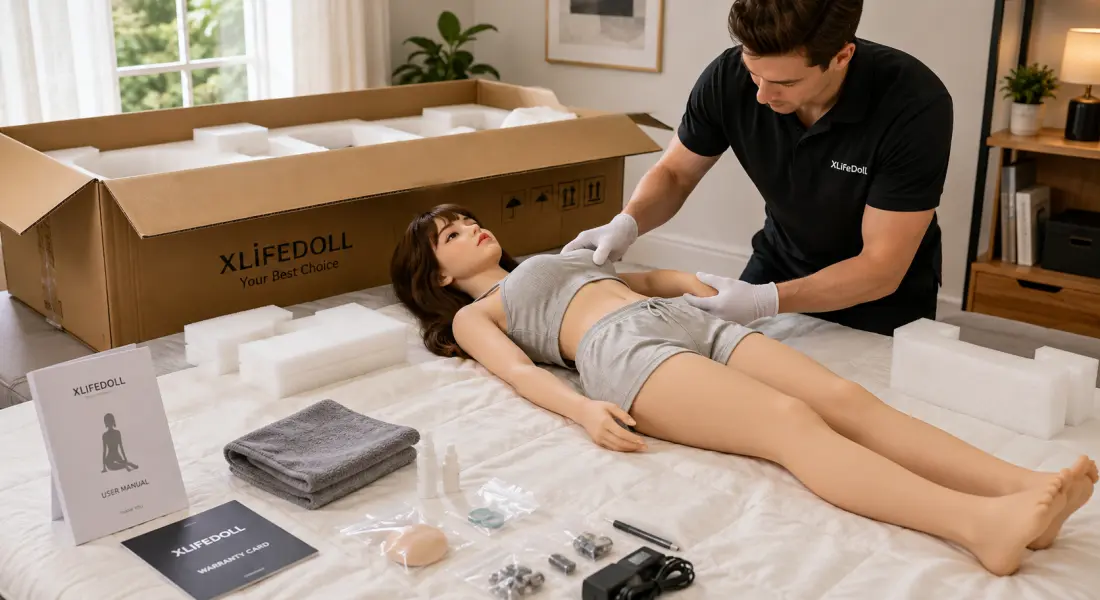
Step 2: Unbox and Lift the Doll Safely
One of the most important first-day principles is:
Do not lift a full-size doll by a small or fragile body part.
Remove loose accessories and protective packing materials before attempting to lift the body.
IDODOLL’s unpacking instructions describe supporting the doll at the back and behind the knees when lifting it from the package. Its guide also calls attention to protecting the fingers and toes during handling.
The exact lifting technique may vary with body size, weight, and model design, but the broader principle is applicable:
Support the weight across major body areas.
Avoid treating the following as primary lifting points:
- fingers;
- hands;
- wrists;
- toes;
- head;
- neck connector;
- other small detachable components.
WM Doll’s documentation reinforces this principle by warning that the hands are not intended to support heavy loads and that concentrated stress around the hands or wrists can damage the material or internal structure.
For heavier models, do not assume that “full-size” means easily manageable by one person. Consider the actual product weight before lifting.
Step 3: Inspect and Document the Doll After Delivery
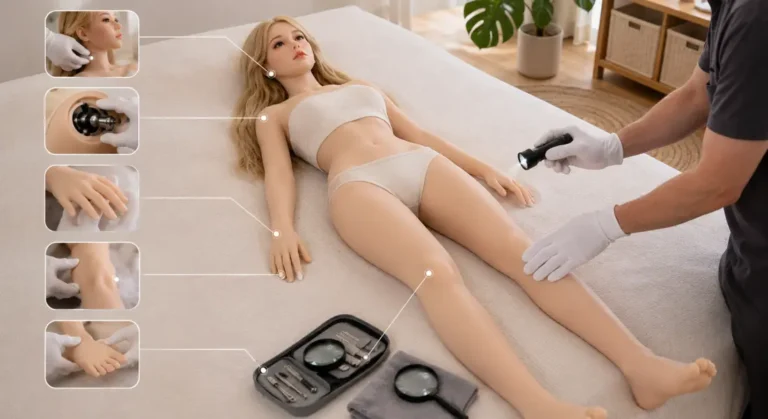
Once the doll has been safely removed from the packaging and placed on a supported surface, perform an initial inspection before extensive posing or handling.
This gives you a baseline for the condition in which the product arrived.
Check the Surface
Look over the main body surface for:
- tears;
- cuts;
- punctures;
- unusual deformation;
- areas that appear significantly different from the surrounding material.
Do not immediately assume that every visible line or surface variation represents damage. Manufacturing methods can leave model- and material-specific characteristics, which we discuss below.
Check the Hands and Fingers
Hands and fingers contain comparatively small structures and deserve particular attention.
Look for obvious surface damage, abnormal finger position, or exposed internal components.
Avoid aggressively straightening a finger simply because its initial position looks unusual.
Check the Feet
Inspect the toes and foot surface for visible shipping damage.
If the model is designed for standing, do not immediately test it by placing the full body weight onto the feet until you understand the manufacturer’s standing and ankle-position requirements.
WM Doll, for example, provides model-specific guidance on correct foot and ankle positioning when standing.
Check the Neck and Connectors
If the head was shipped separately, inspect the neck connection and supplied connector before assembly.
Do not force a connector because it appears close to fitting.
Different products can use different connector systems.
Check Accessories and Detachable Components
Confirm that the expected supplied components are present and inspect them before installation.
For models containing electronics or other special functions, follow the product-specific setup documentation rather than assuming that the setup procedure is identical to a non-electronic model.
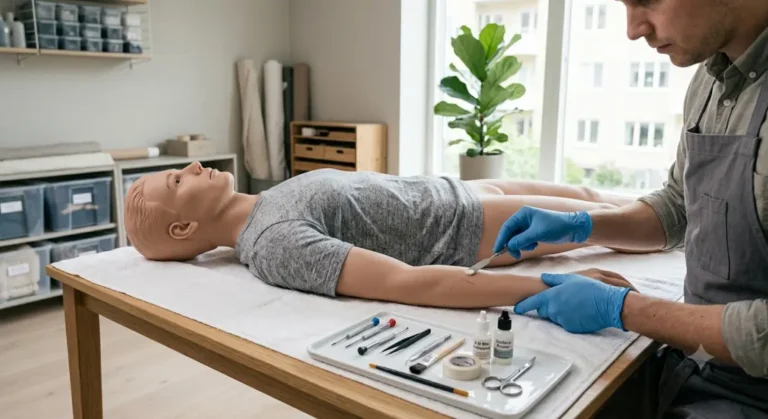
Document Anything Unusual
If you believe something may be damaged:
- stop unnecessary handling of that area;
- photograph the condition clearly;
- record the affected location;
- retain relevant packaging where appropriate;
- contact the seller or support channel if assessment is required.
This is preferable to repeatedly manipulating a questionable area before it has been evaluated.
For a more detailed inspection procedure, see How to Inspect a Sex Doll for Damage.
If You Notice Something Unusual
Photograph it before attempting to clean, repair, reshape, or repeatedly move the affected area.
What Is Normal on a Newly Delivered Doll?
One of the most difficult questions for a first-time owner is:
Is this normal, or is my new doll damaged?
There is no universal visual rule because manufacturing processes, materials, skeletons, finishes, and body designs vary.
However, manufacturer documentation gives us several useful distinctions.
Mold Lines May Be a Manufacturing Characteristic
WM Doll explains that its TPE manufacturing process can leave a visible mold line around the body and small finishing areas around some joints. The manufacturer does not classify these characteristics as manufacturing defects.
This does not mean every line on every doll is normal.
It means that a visible manufacturing line should be evaluated in the context of:
- the material;
- manufacturing method;
- location;
- whether the surface is actually separated or torn.
A superficial mold line and an open material tear are not the same condition.
Temporary Pressure Marks Can Occur
Manufacturer documentation also recognizes pressure and deformation as important material-care issues.
A pressure mark or indentation should not automatically be treated as permanent damage. Its location, severity, duration, material, and recent positioning should be considered before reaching a conclusion. At the same time, severe or persistent deformation deserves further assessment rather than aggressive manipulation.
Surface Condition Depends on Material
TPE and silicone should not be expected to behave identically.
For example, WM Doll discusses TPE oil content and surface maintenance as characteristics of its material system, whereas IDODOLL provides care instructions specifically for silicone products.
This is why identifying the material should precede applying cleaners, powders, oils, or other care products.
A useful first-delivery rule
Observe first. Identify the material and model. Then decide whether intervention is actually necessary.
Step 4: Install the Head and Detachable Components
Some dolls are shipped with the head separated from the body.
Both WM Doll and IDODOLL documentation describe the head as a separate component connected to the body through a mechanical connector.
However, this does not mean every head uses the same connector.
IDODOLL describes its own screw-based installation procedure, while other products may use different connector designs.
Therefore:
- identify the supplied connector;
- check the model-specific installation instructions;
- align the components correctly;
- apply only the force required by the intended mechanism;
- stop if the connector does not seat or engage normally.
Never convert a manufacturer-specific instruction such as “turn clockwise” into a universal assembly rule for every doll.
The same principle applies to detachable or optional components: model-specific instructions override generic setup advice.
Step 5: Review the Care Instructions Before First Use
A common question is whether every new doll must be completely washed immediately after unboxing.
Based on the manufacturer documentation reviewed for this guide, we do not have sufficient cross-manufacturer evidence to state that every new TPE or silicone doll universally requires a complete wash immediately after delivery.
The more reliable rule is:
Identify the material and review the care instructions supplied for your model before first use.
Determine the Material First
At minimum, establish whether the primary body material is:
- TPE;
- silicone;
- or a model incorporating additional special finishes or electronic components.
This matters because material-care procedures are not interchangeable.
WM Doll’s instructions, for example, provide TPE-specific cleaning and Renewal Powder guidance. IDODOLL provides separate guidance for silicone, including suitable mild cleaning agents and cautions against corrosive products and rough cleaning tools.
Follow the Appropriate Cleaning Procedure
If cleaning is required by the manufacturer’s instructions or appropriate for your situation, use a procedure suitable for that material and product design.
Do not assume that a product marketed for one material is automatically suitable for another.
For the complete XLifeDoll cleaning procedure, see How to Clean a Sex Doll Safely.
Dry Completely After Cleaning
Here the manufacturer evidence is much stronger.
Both WM Doll and IDODOLL emphasize thorough drying as part of their respective cleaning procedures. Internal channels and recessed areas require particular attention because moisture can remain after the outer surface appears dry.
If you clean the doll, complete the drying process before proceeding to storage or relevant material aftercare.
See How to Dry a Sex Doll Properly After Cleaning for the full procedure.
Step 6: Learn How to Handle and Move the Doll Safely
Safe ownership requires more than learning how to lift the doll out of its original box.
The same load-distribution principle applies whenever the body is moved.
Support major body areas
Whenever practical, support the torso and lower body rather than transferring the product’s total weight through small joints or extremities.
Protect hands, wrists, fingers, and toes
These areas should not be used as handles.
WM Doll specifically warns against allowing the doll’s weight to be supported through the hands and wrists, while IDODOLL emphasizes protecting fingers and toes during handling.
Avoid hard and sharp contact
Remove watches, sharp jewelry, tools, and other objects that could press into or scrape the surface while moving the doll.
Consider the actual weight
Body height alone does not indicate how difficult a doll will be to handle.
Before moving a full-size model, know its listed weight and plan the movement accordingly.
This is especially important when moving the product between a bed, cleaning area, or storage location.
Step 7: Learn the Joint Movement Before Posing
A newly delivered articulated doll should not be treated like a rigid mannequin or assumed to move exactly like a human body.
Internal skeleton designs have defined movement ranges.
Both WM Doll and IDODOLL provide manufacturer-specific guidance for movement of areas such as the:
- neck;
- shoulders;
- elbows;
- wrists;
- waist;
- hips;
- knees;
- ankles.
The exact angles vary by design, so XLifeDoll does not treat one manufacturer’s ROM figures as universal specifications.
Instead, follow three principles.
Move One Joint Deliberately
When learning a new model, make controlled adjustments rather than immediately attempting a complex full-body pose.
Respect the Intended Range
Do not deliberately force a joint beyond the range specified for the model.
IDODOLL warns that excessive force or movement outside the normal range can contribute to creasing or tearing, while WM Doll documents specific ROM limits for its skeleton design.
Separate Posing From Long-Term Resting
A pose that can be achieved temporarily is not necessarily suitable for long-term storage.
Highly flexed joints and sustained material compression can create unnecessary stress over time.
This distinction becomes particularly important after the first setup, when deciding how the doll should rest between handling sessions.
Step 8: Choose a Safe Resting and Storage Position
After the initial setup is complete, do not simply leave the doll in whichever position was used last.
Long-term storage should reduce unnecessary stress on the material and internal structure.
Across the reviewed manufacturer documentation, several principles are consistent:
- avoid prolonged concentrated pressure;
- avoid unnecessary long-term joint flexion;
- protect the surface from hard or abrasive contact;
- avoid excessive heat;
- avoid prolonged direct sunlight;
- store the product dry.
However, the specific storage method can differ by manufacturer and model.
For example, IDODOLL describes hanging as its preferred method and also discusses returning the doll to the original box when hanging is unavailable. WM Doll discusses storage on an appropriate soft surface and recommends reducing prolonged flexion for long-term storage.
Therefore, XLifeDoll does not recommend one universal storage method for every product.
Instead:
Use a storage method compatible with your model while minimizing prolonged pressure, excessive flexion, heat, sunlight, and surface stress.
For the complete procedure, see How to Store a Sex Doll Safely.
Your First 24-Hour Checklist
Use this checklist after delivery to make sure the important first-day steps have not been overlooked.
Delivery & Unboxing
- Inspect the external package for obvious damage.
- Prepare a clean, padded area before removing the doll.
- Remove accessories and loose protective materials.
- Protect fingers, toes, and other small components during handling.
- Support major body areas when lifting.
Inspection
- Inspect the main surface.
- Check hands, fingers, feet, and toes.
- Inspect the neck and supplied connectors.
- Confirm expected detachable parts and accessories.
- Photograph anything that may represent shipping or product damage.
Setup
- Identify the connector system before installing the head.
- Follow model-specific assembly instructions.
- Do not force a connector or component that does not engage normally.
Care
- Confirm whether the doll is TPE, silicone, or another configuration.
- Review the model-specific care instructions.
- Use only an appropriate cleaning procedure when cleaning is required.
- Make sure cleaned areas are completely dry.
- Apply only material-appropriate aftercare.
Handling & Storage
- Learn basic joint movement before attempting complex poses.
- Do not force joints beyond their intended range.
- Avoid using hands, wrists, fingers, or toes as lifting points.
- Select an appropriate low-stress resting or storage position.
- Keep the doll away from excessive heat and prolonged sunlight.
When Should You Contact Support?
Not every unusual-looking feature means that a new doll is defective. However, some conditions should be documented and assessed rather than ignored or repeatedly manipulated.
Consider contacting the seller or manufacturer if you find:
- an obvious tear, puncture, or open surface separation;
- exposed internal components;
- substantial shipping damage;
- a connector that appears damaged or cannot be installed normally;
- a missing major component;
- a joint that appears mechanically abnormal;
- severe deformation that does not appear to recover;
- an electronic function that does not operate according to its supplied instructions.
Take clear photographs or video before attempting repairs.
This is particularly important with a newly delivered product because self-repair or aggressive manipulation can make it more difficult to determine the original condition.
If you are unsure whether a surface feature represents normal manufacturing finishing or actual damage, document it first and request an assessment.
Frequently Asked Questions
What should I do first when my sex doll arrives?
Inspect the shipping package, prepare a clean and padded work area, remove loose accessories and protective materials, and lift the doll while supporting major body areas. After unpacking, inspect and document the doll before extensive handling or posing.
Should I clean a new sex doll before first use?
Cleaning requirements can vary by material, manufacturer, and model. The manufacturer documentation reviewed by XLifeDoll does not support a universal rule that every doll must receive a complete wash immediately after unboxing. Identify the material and follow the appropriate care instructions for your model.
What should I inspect after unboxing a sex doll?
Inspect the body surface, hands, fingers, feet, toes, neck connector, joints, detachable components, and supplied accessories. Document suspected shipping or product damage before repeatedly manipulating the affected area.
Are mold lines normal on a new sex doll?
They can be normal on some products. WM Doll states that its TPE molding process can leave visible mold lines and certain joint finishing characteristics that it does not classify as manufacturing defects. However, this should not be generalized to every model or used to dismiss an actual tear or surface separation.
How should I lift a full-size sex doll?
Support major areas of the body rather than lifting through the hands, wrists, fingers, toes, head, or other small components. IDODOLL’s unpacking guidance specifically describes supporting the back and behind the knees when removing its product from the package.
Can I pose a sex doll immediately after unboxing?
Basic positioning may be possible, but first familiarize yourself with the model’s joint movement and manufacturer-specific range-of-motion guidance. Do not force joints or assume that every skeleton has identical articulation limits.
Should I apply maintenance powder to a new doll immediately?
Do not treat maintenance powder as a universal requirement for every material. Powdering guidance can be material- and manufacturer-specific. Confirm the body material and follow the appropriate care instructions before applying any maintenance product.
How should I store a new sex doll after setup?
Use a model-appropriate storage method that minimizes prolonged pressure, excessive joint flexion, heat, direct sunlight, and surface stress. If the doll has been cleaned, make sure it is completely dry before storage.
How This Guide Was Developed
This guide was developed by reviewing manufacturer operation and maintenance documentation covering unboxing, handling, assembly, material care, joint movement, and storage. Where manufacturer instructions differ by material or product design, XLifeDoll treats those recommendations as model-specific rather than universal rules.
Related Care & Ownership Guides
How to Clean a Sex Doll Safely
Step-by-step guidance for routine cleaning while protecting the material and internal components.
How to Dry a Sex Doll Properly After Cleaning
Learn how to remove residual moisture before aftercare or storage.
How to Inspect a Sex Doll for Damage
Understand what areas to inspect and how to identify potential surface or structural problems.
How to Store a Sex Doll Safely
Learn how positioning, pressure, temperature, and storage conditions can affect long-term care.
How to Apply Maintenance Powder to a TPE Sex Doll
Understand when and how maintenance powder should be used on compatible TPE surfaces.