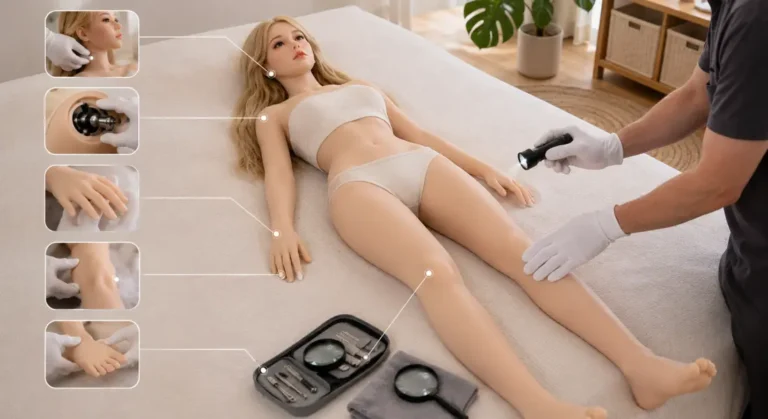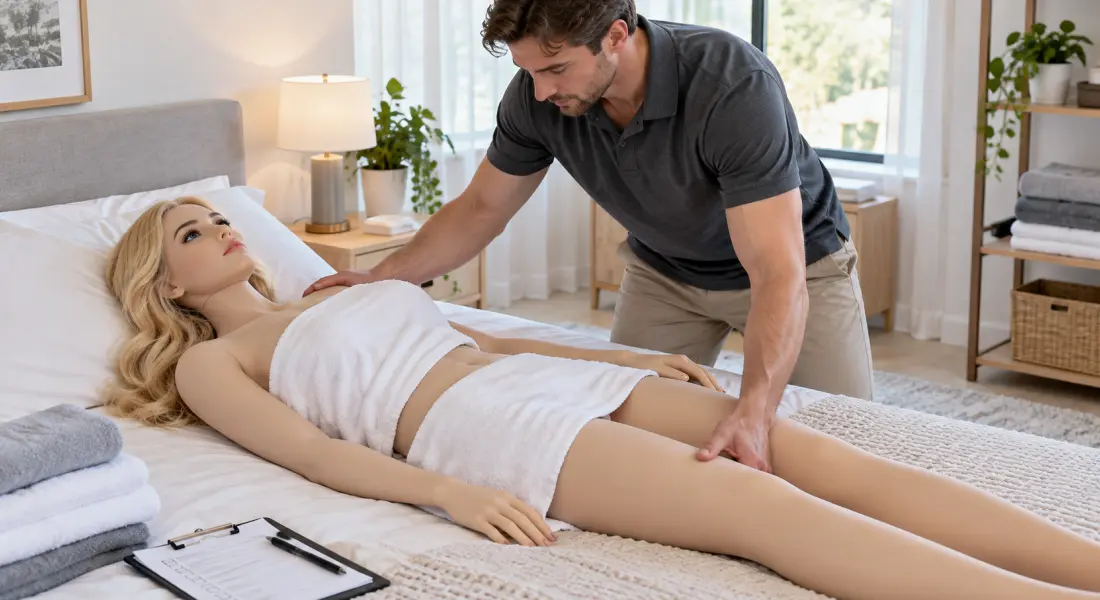
Moving and posing a sex doll may look simple, but most damage related to handling happens when too much force is applied to the joints, soft material, or high-stress areas of the body.
The safest approach is not to force the doll into a position quickly. Instead, support the body, move one joint at a time, stay within the model’s normal range of motion, and avoid leaving the doll in highly flexed or compressed poses for long periods.
The exact movement limits can vary by skeleton design and model, so manufacturer-specific guidance should always take priority over general advice.
On This Page
- Why Safe Handling Matters
- Understand the Skeleton Before Posing
- Support the Doll Before Moving It
- Move One Joint at a Time
- Never Force a Joint Past Resistance
- Protect High-Stress Material Areas
- Be Careful With Seated and Deeply Bent Poses
- How to Move a Doll Between Locations
- Standing and Upright Poses
- What to Do if a Joint Feels Too Tight
- What to Do if a Joint Feels Too Loose
- Inspect the Doll After Major Position Changes
- Common Posing Mistakes
- Conclusion
- Frequently Asked Questions
Why Safe Handling Matters
A sex doll is usually built around an internal articulated skeleton covered by TPE, silicone, or another soft outer material.
When the body is moved, two systems are affected at the same time:
Internal skeleton + external soft material
A pose that is mechanically possible for the skeleton may still place unnecessary stress on the surrounding material.
This is why safe movement is not just about whether a joint can bend.
It is also about:
- how much force is required;
- how the surrounding material stretches;
- whether the body is supported;
- how long the pose is maintained.
Understand the Skeleton Before Posing
Different dolls can use different internal skeleton designs.
Depending on the model, the skeleton may include articulated joints at areas such as:
- shoulders;
- elbows;
- wrists;
- fingers;
- hips;
- knees;
- ankles;
- neck.
Some models may also use more advanced skeleton systems with additional articulation.
However, more articulation does not automatically mean every joint should be moved farther or with greater force.
Three characteristics should be kept separate:
Range of Motion
How far a joint can move.
Joint Resistance
How much force is required while moving the joint.
Pose Holding
How strongly the joint holds its position after movement.
These are different characteristics.
A joint can have:
high resistance + strong pose holding
or:
lower resistance + weaker pose holding.
Do not assume stiffness automatically means damage, but unusual resistance should never be overcome by simply applying more force.
Support the Doll Before Moving It
One of the most important handling rules is:
Do not let the full weight of the doll hang from one limb or joint.
Before moving a major body section, support the weight around the:
- torso;
- hips;
- thighs;
- shoulders.
For heavier dolls, it may be safer to reposition the body in stages instead of lifting and rotating the entire doll at once.
For example:
- stabilize the torso;
- adjust the hips;
- reposition the legs;
- adjust the upper body;
- refine the final pose.
This reduces unnecessary leverage on individual joints.
Move One Joint at a Time
Trying to move several parts of the body at once can create twisting forces.
A better approach is:
One joint → one movement → reassess → continue
For example, when changing an arm position:
- support the upper arm;
- move the shoulder gradually;
- adjust the elbow separately;
- adjust the wrist afterward.
The same principle applies to the legs.
Move:
hip → knee → ankle
instead of pulling the entire leg into position in one motion.
Never Force a Joint Past Resistance
Joint resistance is normal to some extent because the skeleton must hold poses.
What matters is how the resistance feels.
If movement is smooth and controlled, continue gradually.
If you notice:
- sudden locking;
- abrupt mechanical resistance;
- clicking;
- grinding;
- unusual asymmetry;
- a joint that suddenly requires much more force than before;
stop.
Do not use body weight, leverage, tools, or repeated force to overcome the resistance.
The exact cause of unusually stiff movement cannot be determined from resistance alone.
Possible explanations may involve joint adjustment or skeleton design, but unless the manufacturer has confirmed the cause, it should not be assumed.
Protect High-Stress Material Areas
Soft outer material can stretch significantly around moving joints.
Some areas deserve extra attention because movement can create concentrated tension.
These include:
- armpits;
- groin;
- inner thighs;
- shoulder transitions;
- hips;
- knees;
- elbows.
Manufacturer care guidance for TPE products commonly warns against excessive stretching, especially around areas such as the armpits and groin.
The basic rule is:
If the surface becomes highly stretched, stop increasing the pose.
Do not assume the skeleton’s maximum movement range is also the safe maximum for the outer material.
Be Careful With Seated and Deeply Bent Poses
Deeply bent or compressed poses can place sustained pressure on both the material and internal structure.
Examples include:
- tightly bent knees;
- strongly flexed hips;
- prolonged seated positions;
- deep folding at the waist;
- limbs pressed against the body for long periods.
Some manufacturer maintenance guidance notes that prolonged seated or flexed positions can contribute to creasing or deformation in soft materials.
Therefore, highly compressed poses are better treated as temporary positions rather than long-term storage positions.
After use, return the doll to a more neutral position.
How to Move a Doll Between Locations
Transporting the entire doll is different from changing a pose.
For a heavy full-size doll, avoid lifting by:
- wrists;
- forearms;
- ankles;
- neck;
- one shoulder;
- one leg.
Instead, support the major mass of the body.
A practical method is to support:
upper torso + hips
or:
torso + thighs
depending on the doll’s weight and design.
For heavier models, moving in stages may be safer than carrying the doll in one continuous movement.
Avoid Dragging the Doll
Dragging the doll across:
- flooring;
- bedding;
- rough upholstery;
- carpet;
can create friction or surface stress.
Instead, lift or reposition the body with adequate support.
If the doll is too heavy to move safely, use an appropriate support system or ask another person for assistance.
Standing and Upright Poses
Some dolls are designed with standing-foot systems or reinforced feet.
Others are not.
Never assume every doll can stand independently.
Before using an upright pose, confirm:
- whether the model supports standing;
- whether standing bolts or reinforced feet are present;
- what surface is suitable;
- whether external support is recommended.
Even when standing is supported, the doll should not be left unstable or unattended where it could fall.
A fall can damage:
- the face;
- fingers;
- feet;
- skeleton;
- surface material.
What to Do if a Joint Feels Too Tight
If a joint feels significantly tighter than expected:
- stop applying additional force;
- return the limb to a neutral position if possible;
- compare movement with the opposite side;
- inspect the surrounding material;
- check the manufacturer’s movement guidance;
- contact the seller or manufacturer if the resistance appears abnormal.
Do not assume the correct response is simply:
“push harder.”
A joint that requires excessive force may need inspection or model-specific guidance.
What to Do if a Joint Feels Too Loose
A loose joint presents a different problem.
Signs may include:
- the limb will not hold a pose;
- the joint drops under its own weight;
- movement feels unusually free;
- the joint angle changes without resistance.
In this situation:
- avoid unsupported poses;
- reduce stress on the affected joint;
- document the issue;
- contact the seller or manufacturer before attempting internal adjustment.
Unless the manufacturer provides a repair procedure, opening the body or tightening internal hardware without guidance can create additional damage.
Inspect the Doll After Major Position Changes
After moving the doll into a new or demanding pose, briefly inspect:
- armpits;
- groin;
- knees;
- elbows;
- hips;
- feet;
- hands;
- areas under sustained pressure.
Look for:
- unusual stretching;
- creases;
- tears;
- surface marks;
- joint instability;
- material compression.
Early inspection can help identify small problems before they become larger.
For a full inspection procedure, see:
How to Inspect a Sex Doll for Damage
Common Posing Mistakes
Pulling a Limb Instead of Supporting It
This increases leverage on the joint and material.
Better approach
Support the limb close to the joint and move gradually.
Moving Several Joints at Once
This can create twisting forces.
Better approach
Adjust one joint at a time.
Forcing Through Resistance
Resistance is not permission to apply unlimited force.
Better approach
Stop when movement becomes abnormal.
Stretching the Armpits or Groin Too Far
These areas can experience concentrated material stress.
Better approach
Watch the surface while moving the limb.
Leaving the Doll in a Deeply Bent Pose for Long Periods
This may contribute to creases or deformation in some soft materials.
Better approach
Return the doll to a neutral position after use.
Using the Wrong Storage Pose
A pose that looks natural may not be suitable for long-term storage.
Better approach
Use a low-stress storage position.
See:
How to Store a Sex Doll Safely
A Simple Safe-Posing Workflow
For everyday use, the safest sequence is:
Support → Move Slowly → One Joint at a Time → Watch the Material → Stop at Abnormal Resistance → Inspect
This approach does not require knowing the exact internal joint design.
It simply reduces avoidable stress during normal handling.
Conclusion
Safe posing is not about making a sex doll move as far as possible.
It is about balancing three things:
Joint movement + body support + material protection
To reduce avoidable damage:
- support the doll before moving it;
- move one joint at a time;
- stay within the model’s normal movement range;
- avoid excessive stretching;
- do not force tight joints;
- avoid leaving the doll in highly compressed positions for long periods;
- inspect high-stress areas after significant repositioning.
Because skeleton designs differ, model-specific manufacturer instructions should always take priority over general guidance.
Frequently Asked Questions
How should I move a sex doll safely?
Support the torso and heavier body sections, move joints slowly, and adjust one joint at a time. Avoid lifting the doll by a single limb or forcing joints through strong resistance.
Can I move a sex doll joint as far as it will go?
Not necessarily. The internal skeleton may allow more movement than the surrounding soft material can tolerate safely. Stay within the manufacturer-supported range and stop if the material becomes highly stretched.
Why are some sex doll joints stiff?
Some joint resistance is necessary for pose holding. However, unusually high resistance can have different causes and should not automatically be attributed to one mechanical issue without manufacturer confirmation.
Can I leave a sex doll sitting for a long time?
Long periods in strongly flexed or compressed positions can place sustained pressure on soft materials and may contribute to creasing or deformation. A more neutral position is generally better for long-term storage.
Which areas are most vulnerable when posing a sex doll?
High-stress areas can include the armpits, groin, inner thighs, hips, knees, elbows, and shoulder transitions. Watch these areas while changing poses.
What should I do if a joint suddenly becomes very tight?
Stop forcing the movement. Return the limb to a neutral position if possible, inspect the surrounding material, compare the opposite joint, and contact the seller or manufacturer if the resistance appears abnormal.
What should I do if a joint becomes loose?
Avoid unsupported poses, document the problem, and contact the seller or manufacturer before attempting internal adjustments unless an approved repair procedure is available.