Article Navigation
- Quick Answer
- What Actually Makes a Sex Doll Realistic?
- Visual Realism: Skin, Color & Surface Detail
- Tactile Realism: Why Softness Alone Is Not Enough
- Material Elasticity & Recovery
- Dynamic Filling & Soft-Tissue Movement
- Internal Structure & Controlled Resistance
- Joint Mechanics & Natural Posing
- Sensors & Interactive Realism
- Manufacturer Technology Examples
- Which Technology Affects Which Type of Realism?
- Which Realism Technologies Matter Most to You?
- Realism Claims: What Buyers Should Verify
- Key Takeaways
- Frequently Asked Questions
Quick Answer
What makes a sex doll realistic is not one single material or feature.
The most convincing models combine several layers of realism:
- realistic skin color and surface detail
- controlled softness and elastic recovery
- dynamic movement under pressure
- stable but natural joint articulation
- appropriate weight distribution
- realistic internal structure
- optional sensors or smart interaction
In practical terms:
Realism is a system, not a single feature.
An ultra-soft body can still feel artificial if it lacks shape recovery or natural movement. A highly detailed face can still look less convincing if the skin surface reflects light unnaturally. Likewise, flexible joints are only useful when they can hold poses without overstressing surrounding materials.
What Actually Makes a Sex Doll Realistic?
“Realistic” is one of the most widely used terms in the sex doll market, but it can describe very different things.
For one buyer, realism may mean a detailed face.
For another, it may mean softer skin, natural body movement, realistic weight, or hands that can hold believable poses.
A more useful way to evaluate realism is to separate it into five categories.
Visual Realism
This includes:
- skin tone
- pigmentation
- facial sculpting
- pores and surface detail
- eyes
- hair
- light reflection
Tactile Realism
This includes:
- surface friction
- softness
- elasticity
- local deformation
- material recovery
Dynamic Realism
This describes how the body behaves when moved or compressed:
- inertia
- secondary motion
- delayed recovery
- soft mass displacement
- movement transitions
Mechanical Realism
This depends on:
- skeleton design
- joint resistance
- range of motion
- pose stability
- finger and hand articulation
Interactive Realism
On selected advanced models, physical realism may also be combined with:
- touch sensors
- heating
- voice interaction
- facial responses
- smart head systems
- AI functions
These layers should be evaluated separately before judging the overall realism of a model.
Visual Realism: Skin, Color & Surface Detail
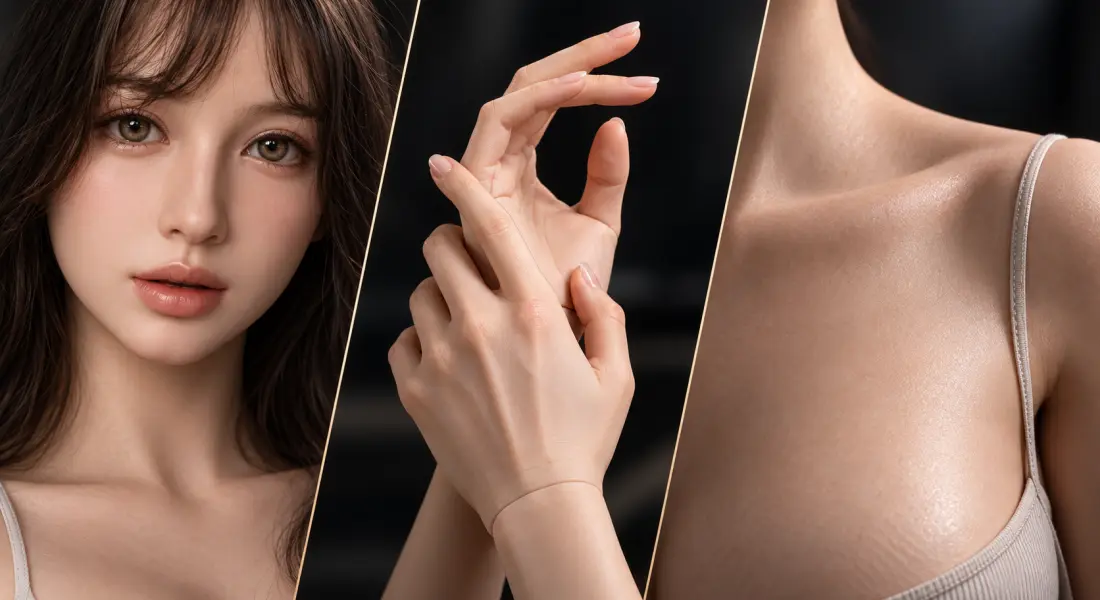
Realistic skin is not simply one uniform color.
Human skin shows subtle variation in:
- tone
- saturation
- shadow
- translucency
- surface reflection
High-end finishing techniques may use multiple pigment layers or localized coloration to create greater visual depth.
The goal is not stronger color.
The goal is more natural light behavior.
A flat or overly uniform finish can make even a detailed sculpt look artificial under changing lighting conditions.
Areas that can influence visual realism include:
- lips
- cheeks
- nipples
- veins
- eyebrows
- fingernails
- facial shading
The surface itself also matters.
A perfectly smooth material may reflect light differently from a finely textured surface, especially in close photography or strong directional lighting.
Hair and Visual Consistency
Hair can change the perceived proportions of a face almost as much as the sculpt itself.
A poorly fitted generic wig may reduce realism even when the head is highly detailed.
Factors to consider include:
- hairline
- density
- length
- face framing
- color
- symmetry
Depending on the head design, a doll may use:
- removable wigs
- implanted hair
- interchangeable hair systems
No one approach is automatically superior. The best choice depends on appearance, maintenance, and the construction of the head.
Tactile Realism: Why Softness Alone Is Not Enough
Softness is often treated as the primary measure of realism.
That is incomplete.
A realistic material should not only compress under pressure. It should also respond predictably and recover its shape.
Important characteristics include:
- local softness
- surface friction
- elastic recovery
- form stability
- pressure distribution
If a material is extremely soft but lacks adequate recovery, it may deform too easily.
If it is too firm, it may feel less natural.
The objective is therefore not maximum softness.
It is:
controlled softness with stable recovery.
Microtextured Skin Surfaces
Microtexture can influence both how a surface looks and how it feels.
Fine surface structures may change:
- light diffusion
- friction
- gloss
- tactile variation
This is why a lightly textured surface may appear more natural than a completely smooth one.
Microtexture is especially relevant in close-up photography, where surface reflection can strongly affect whether the skin appears natural or synthetic.
Manufacturer Example: Elastic Skin Response
One manufacturer demonstration reviewed for this guide shows a highly elastic skin structure under local pressure.
The visible behavior includes:
- clear local deformation
- soft compression
- visible return toward the original shape
- smooth surface movement
- controlled rebound
The manufacturer refers to this system as CloudTouch.
From a technical standpoint, the important observation is not the trade name itself.
It is the physical behavior:
local softness combined with elastic recovery.
The demonstration does not establish:
- the exact silicone formulation
- Shore hardness
- long-term fatigue resistance
- measured service-life improvement
Those claims would require separate technical documentation or testing.
Material Elasticity & Recovery
Material response can be understood through several practical questions.
How Much Does the Material Deform?
Some materials compress deeply under relatively light pressure, while others resist deformation more strongly.
How Quickly Does It Recover?
Fast recovery creates a different feel from slower, softer rebound.
Does the Shape Remain Stable?
Repeated compression should not automatically be assumed to have no long-term effect.
How Is Pressure Distributed?
A material that spreads pressure across a larger area behaves differently from one that compresses mainly at the contact point.
These factors influence realism more meaningfully than a simple marketing label such as “ultra-soft.”
Dynamic Filling & Soft-Tissue Movement
Realism also depends on what happens below the outer skin.
A body section with a uniform solid interior tends to respond differently from one using softer internal structures.
Depending on the model, manufacturers may use:
- soft silicone
- gel
- fluid-like filling
- foam
- layered structures
- hybrid constructions
These systems can change:
- compression behavior
- mass movement
- inertia
- secondary motion
- recovery speed
This is particularly noticeable in body areas where natural tissue would normally move after an external force stops.
Manufacturer Example: Dynamic Soft-Tissue Motion
A second manufacturer demonstration reviewed for this guide shows visible delayed movement after the body section is pushed or moved.
The observed behavior includes:
- secondary motion
- delayed rebound
- softer movement transitions
- inertial-looking mass displacement
- continued movement after the initial force ends
The manufacturer calls this system AquaBounce.
A neutral technical description would be:
dynamic mass movement with delayed recovery.
The video supports the existence of that movement behavior.
However, the demonstration alone does not confirm whether the internal system uses:
- liquid chambers
- gel
- another soft filling
- a hybrid internal structure
That distinction should only be stated when supported by manufacturer construction documentation.
Solid, Gel and Dynamic Filling Systems
| Internal Structure | Typical Behavior |
|---|---|
| Solid filling | Stable shape, limited secondary motion |
| Soft silicone structure | Greater local compression |
| Gel-based filling | Softer pressure distribution |
| Fluid-like structure | More delayed mass movement |
| Hybrid construction | Combines multiple behaviors |
There is no universally “best” option.
Different buyers may prefer stability, softness, movement, lower weight, or easier maintenance.
Internal Structure & Controlled Resistance
The outer material is only one part of the experience.
Internal geometry can also change how a product responds to pressure.
Relevant variables may include:
- wall thickness
- depth
- material firmness
- internal geometry
- cross-sectional shape
Two products made from similar external material can therefore behave very differently.
From an engineering perspective, internal structure helps define:
where the material compresses, how much resistance is created, and how force is distributed.
This is one reason why material names alone do not fully describe the user experience.
Joint Mechanics & Natural Posing
A realistic body also needs believable mechanical movement.
Joint design affects:
- posing
- posture
- hand position
- range of motion
- stability
- how natural a pose appears
Joint resistance is particularly important.
A joint that is too loose may not hold a position.
A joint that is too stiff may be difficult to move and can place unnecessary tension on surrounding material if forced.
A well-balanced joint system aims for:
controlled movement with enough resistance to hold a pose.
Manufacturer Example: Fine Joint Articulation
The third manufacturer demonstration reviewed for this guide focuses mainly on small joints and hand movement.
Visible characteristics include:
- individual finger positioning
- small-angle articulation
- more varied hand poses
- controlled finger movement
- more natural-looking hand placement
The manufacturer refers to this system as Grace Joint.
The demonstration supports a more specific conclusion:
Fine articulation can improve the realism of small hand and finger poses.
It does not, by itself, prove:
- longer overall material lifespan
- reduced shoulder or hip stress
- lower tear rates
- improved durability across the entire skeleton
Those claims would require separate mechanical or long-term testing.
More Flexibility Is Not Always Better
Maximum range of motion is not automatically the goal.
A useful joint system must balance three things:
- natural positioning
- stable pose retention
- protection of surrounding material
This matters especially around:
- fingers
- wrists
- shoulders
- hips
- knees
Joints should not be forced beyond clear mechanical resistance.
Sensors & Interactive Realism
Material and movement create passive realism.
Sensors and smart systems can add interactive realism.
Depending on the model, advanced products may include:
- touch sensors
- heating
- microphones
- voice systems
- smart head modules
- facial-expression mechanisms
- AI functions
These features should not be treated as standard equipment on every realistic sex doll.
A premium silicone or TPE doll can be highly realistic without any electronic sensors.
Interactive systems are therefore an additional technology layer rather than a requirement for physical realism.
Passive vs. Interactive Realism
Passive Realism
- skin
- material
- gel
- filling systems
- skeleton
- joints
- weight
- surface texture
Interactive Realism
- sensors
- heating
- AI
- voice interaction
- facial response
- electronic controls
Buyers should evaluate these two areas separately.
Which Technology Affects Which Type of Realism?
| Technology | Main Effect |
|---|---|
| Multi-layer pigmentation | Visual depth |
| Microtextured surface | Skin appearance and friction |
| Elastic material systems | Recovery behavior |
| Soft or gel filling | Pressure distribution |
| Dynamic filling | Secondary movement and inertia |
| Precision joints | Posing and movement |
| Skeleton structure | Stability |
| Sensors | Interactive feedback |
| AI systems | Digital interaction |
Which Realism Technologies Matter Most to You?
Not every buyer needs every technology.
A better buying decision starts with the experience you actually want.
| Your Priority | Technologies to Compare |
|---|---|
| Better visual realism | Pigmentation, face sculpt, surface finish |
| Softer touch | Material softness, microtexture, elasticity |
| Natural body movement | Dynamic filling, mass distribution |
| Better posing | Skeleton, joint resistance, finger articulation |
| Structural stability | Skeleton design, material recovery |
| Smart interaction | Sensors, AI, heating, smart modules |
This is more useful than simply looking for the product with the longest feature list.
Realism Claims: What Buyers Should Verify
The sex doll market uses many proprietary technology names.
These can be useful, but they should not replace actual specifications.
Before purchasing, translate marketing claims into observable questions.
“Ultra-soft”
Ask:
- How does the material recover after compression?
- Which areas use the softer material?
- Is the entire body soft or only selected zones?
“Dynamic” or “fluid”
Ask:
- What is actually inside the structure?
- Is it gel, fluid, silicone, foam, or a hybrid system?
- Is the construction documented?
“Advanced joints”
Ask:
- Which joints are upgraded?
- Can they hold poses?
- Are fingers individually articulated?
“AI”
Ask:
- What does the system actually do?
- Is it voice interaction, sensors, facial movement, or full robotics?
- Does it require Wi-Fi or software?
This distinction matters because a trade name describes a product concept, while engineering behavior describes what the product actually does.
How to Interpret Manufacturer Technology Names
The three manufacturer terms discussed in this guide can be translated into more neutral technical descriptions:
CloudTouch
→ elastic skin response and surface softness
AquaBounce
→ dynamic mass movement and delayed rebound
Grace Joint
→ fine joint articulation and more precise finger positioning
This approach makes different manufacturer technologies easier to compare.
System Integration Matters More Than One Feature
A highly realistic sex doll is not created by maximizing one characteristic.
A very soft body may still feel less convincing if:
- the joints move unnaturally
- the surface reflects light poorly
- the internal structure feels static
- the skeleton cannot maintain a natural pose
Likewise, advanced joints cannot compensate for an artificial-looking surface.
The most convincing designs therefore integrate several systems:
- visual depth
- microtextured skin
- controlled elasticity
- dynamic material movement
- mechanical precision
- structural stability
- optional interactive technology
This is the central principle behind modern realism engineering.
Key Takeaways
- A realistic sex doll is not defined by softness alone.
- Visual, tactile, dynamic, mechanical, and interactive realism are separate factors.
- Surface texture and pigmentation influence how realistic skin looks under different lighting.
- Material elasticity affects both compression and shape recovery.
- Dynamic filling systems can create more delayed and natural-looking body movement.
- Fine joint articulation can improve hand and finger posing.
- Manufacturer trade names should be translated into observable physical behavior.
- Sensors and AI are optional layers of realism, not requirements for a realistic physical doll.
- The best technology depends on how you plan to use, pose, maintain, and interact with the product.
Frequently Asked Questions
What makes a sex doll truly realistic?
Realism comes from the combination of skin appearance, surface texture, material elasticity, internal movement, joint mechanics, structural stability, and—on some models—interactive technology.
Is softer silicone always more realistic?
No. Softness is only one factor. Recovery, form stability, surface texture, and movement behavior also affect realism.
What does microtextured skin do?
Microtexture changes how light reflects from the surface and how the material feels during contact, which can make the skin appear and feel less uniformly synthetic.
What is the difference between dynamic filling and solid filling?
Dynamic filling can produce delayed movement or secondary mass displacement after an external force. Solid filling generally responds more directly and remains more stable.
What does AquaBounce demonstrate?
The reviewed manufacturer demonstration shows delayed secondary movement and softer mass displacement. The exact internal filling structure cannot be confirmed from the video alone.
What is special about Grace Joint?
The demonstration shows more precise positioning of individual fingers and small joints, allowing more natural-looking hand poses.
Do realistic sex dolls always have sensors?
No. Sensors are optional and model-specific. A premium silicone or TPE doll can be physically realistic without electronics.
What technologies should I compare before buying?
Compare material type, skin texture, elasticity, internal filling, joint design, skeleton, weight, and—if relevant—sensors, heating, or AI features.