Article Navigation
- TPE vs. Silicone: Quick Comparison
- What Is TPE?
- What Is Silicone?
- How TPE and Silicone Differ in Real-World Use
- Pressure, Creasing, and Deformation
- Stretching and Mechanical Stress
- Heat and UV Exposure
- Clothing and Dye Transfer
- Cleaning and Drying Differences
- Powder and Surface Care
- Lubricant Compatibility
- Storage Differences
- Which Is Better: TPE or Silicone?
- How to Choose Based on Ownership Needs
- Related Care & Maintenance Guides
- FAQ
Before You Start
This article compares material categories and documented material behavior.
It does not assume that every TPE formulation is identical or that every silicone formulation has the same properties.
That means:
- TPE should not automatically be described as
medical-grade TPE. - Silicone should not automatically be described as
platinum silicone. - A material label does not prove a specific hardness, lifespan, thermal limit, or chemical resistance.
- Product-specific manufacturer instructions take priority over generic material advice.
This same evidence rule is already part of XLifeDoll’s product content standards: material grades must only be used when explicitly verified.
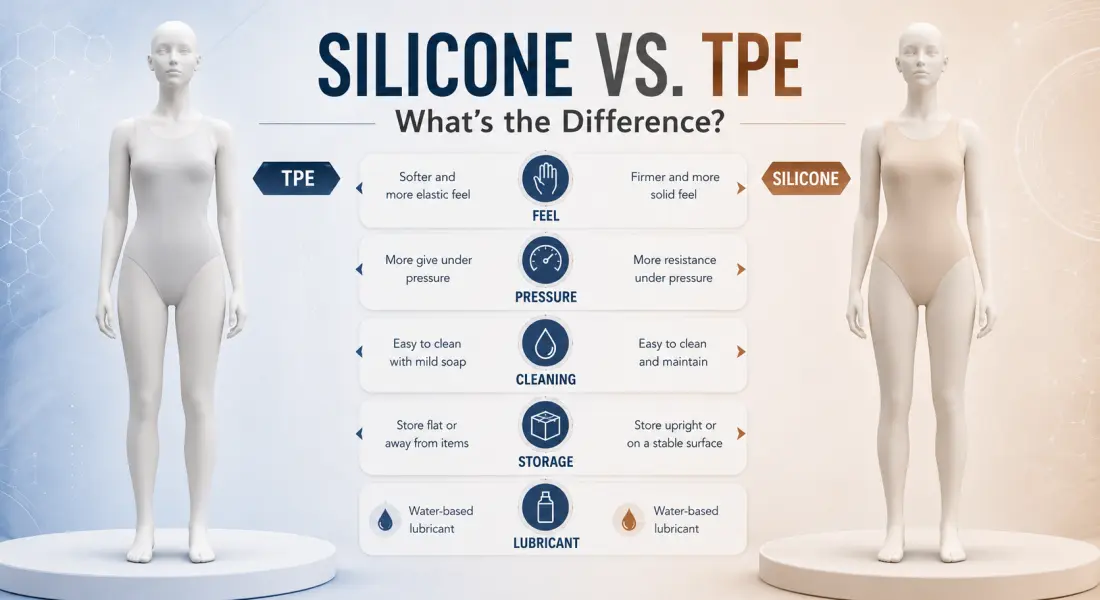
TPE vs. Silicone: Quick Comparison
The following table is intended as a practical orientation, not a universal engineering specification.
| Factor | TPE | Silicone |
|---|---|---|
| Material class | Thermoplastic elastomer | Cured silicone elastomer |
| Exact formulation | Manufacturer-specific | Manufacturer-specific |
| Softness / flexibility | Can be very soft and flexible depending on formulation | Depends on formulation and hardness |
| Pressure sensitivity | Prolonged pressure and flexed positioning are documented concerns for current WM TPE products | Product-specific; follow manufacturer guidance |
| Stretching | Excessive stretching can contribute to tearing | Avoid overstretching; product-specific limits matter |
| Heat | Concentrated heat can damage documented TPE products | Follow manufacturer-specific thermal guidance |
| UV | Prolonged UV exposure is documented to degrade WM TPE | Product-specific; prolonged direct sunlight should still be avoided unless otherwise specified |
| Dye transfer | Documented concern with dark fabrics in current WM TPE guidance | Product-specific; do not assume identical behavior |
| Powder care | Renewal powder is part of documented WM TPE maintenance | Do not assume the same routine for silicone |
| Lubricant | Water-based lubricant specified for current WM TPE documentation | Confirm product-specific compatibility |
| Storage | Pressure, folding, contact surfaces, and position matter | Follow product-specific storage instructions |
The important takeaway is:
The material category influences ownership, but the specific product construction determines the actual experience.
What Is TPE?
TPE stands for Thermoplastic Elastomer.
In the WM DOLL technical documentation reviewed by XLifeDoll, the doll is described as a multi-component structure consisting of:
- a TPE exterior layer;
- an internal metal skeleton;
- hard structural components used to maintain alignment during production.
This distinction is important because a TPE doll is not simply a solid piece of soft material.
The external material must work together with:
- internal joints;
- load-bearing structures;
- connectors;
- standing mechanisms;
- other internal components.
That is why the mechanical limits of the skeleton and the safe deformation limits of the TPE surface are related—but not identical.
TPE Manufacturing Characteristics
The same WM DOLL documentation describes a two-part molding process in which the material is injected in liquid form.
As a result, visible mold lines and certain small finishing areas around joints can be expected manufacturing characteristics rather than automatic evidence of damage.
This is useful for owners because:
A visible surface line is not necessarily the same thing as an open tear.
What Is Silicone?
Silicone sex dolls use a cured silicone elastomer as the primary external body material.
However, silicone is still a broad material category.
The material label alone does not establish:
- the exact formulation;
- hardness;
- curing chemistry;
- tear strength;
- compression behavior;
- thermal limits;
- surface treatment;
- whether the product uses a special certified silicone grade.
How TPE and Silicone Differ in Real-World Use
For most owners, material differences become meaningful only when they affect everyday handling.
The most practical areas to compare are:
- softness and compression;
- pressure sensitivity;
- stretching;
- heat exposure;
- clothing contact;
- cleaning;
- surface care;
- lubricant compatibility;
- storage.
These factors usually matter more than a simple label such as:
“TPE is softer”
or
“Silicone is more durable.”
Those statements are too broad to describe every product accurately.
Feel and Flexibility
Material feel depends on more than the base material.
Important variables include:
- formulation;
- hardness;
- material thickness;
- internal foam or lightweight construction;
- body geometry;
- surface finish;
- local material distribution.
This means two TPE dolls can feel noticeably different from each other.
The same is true for silicone dolls.
Therefore:
Do not choose a doll based on the material name alone if feel is one of your main priorities.
Whenever possible, compare:
- manufacturer hardness information;
- actual body construction;
- product weight;
- soft-body options;
- customer or product testing information.
Pressure, Creasing, and Deformation
Pressure sensitivity is one of the clearest areas where current manufacturer evidence gives us useful TPE-specific information.
WM DOLL warns against leaving its TPE products in prolonged seated or flexed positions because creases can develop where the material remains folded, and longer-term deformation may result.
The manufacturer also recommends:
- storing on a soft surface;
- alternating positions;
- straightening hands and legs for long-term storage.
This gives us an important ownership principle:
Soft material should not be confused with unlimited resistance to long-term pressure.
A flexible body can still develop problems when:
- the same area remains compressed;
- joints remain deeply flexed for long periods;
- the body rests on hard edges;
- soft areas carry concentrated weight.
For a complete storage procedure, link this section to:
How to Store a Sex Doll Safely
Stretching and Mechanical Stress
A doll may be capable of a pose mechanically while still placing excessive stress on the outer material.
WM DOLL’s ROM documentation repeatedly illustrates this distinction.
Examples include warnings that excessive movement can contribute to:
- armpit tearing;
- groin-area tearing;
- permanent TPE damage;
- damage to internal hardware.
The manufacturer also warns against:
- extreme stretching of the limbs;
- excessive kneading;
- supporting body weight through the wrists or palms.
This leads to one of the most important ownership rules:
Skeleton movement capacity is not the same as safe material movement capacity.
This principle applies especially when learning how to pose a new doll.
Heat and UV Exposure
TPE and Concentrated Heat
WM DOLL specifically warns owners not to use a hair dryer on its TPE products because concentrated heat can permanently damage the material.
At the same time, the manufacturer allows a warm—not hot—cloth as a possible method for addressing certain pressure marks.
This tells us something important:
Controlled mild warmth and concentrated high heat are not equivalent.
The wrong conclusion would be:
“TPE must never experience any warmth.”
The better conclusion is:
Avoid uncontrolled or concentrated heat unless the manufacturer specifically permits the method.
For a detailed explanation, link to:
Why You Should Never Use a Hair Dryer on a TPE Sex Doll
UV Exposure
WM DOLL also states that prolonged direct sunlight can degrade its TPE material.
That makes windowsills, direct sunlight, and prolonged UV exposure poor long-term storage environments for documented TPE products.
We do not extend that evidence into a universal statement such as:
“All silicone is UV-proof.”
Current manufacturer evidence does not support that claim.
Clothing and Dye Transfer
TPE can be particularly sensitive to certain textile dyes.
The WM DOLL documentation states that dark fabrics or patterns can bleed into the TPE material and that these stains can be difficult or impossible to remove.
The manufacturer recommends testing unfamiliar fabrics on a TPE sample before extended contact.
The practical ownership model is:
Dark or unstable textile dye
→ prolonged material contact
→ possible dye transfer
→ difficult stain removal
That is more useful than the overly simple rule:
“Never use dark clothes.”
The real issue is dye stability and contact duration.
Oil Leaching and Contact Surfaces
The same manufacturer documentation notes that TPE can release oils onto porous materials such as:
- leather;
- unfinished wood.
This creates a two-way compatibility question:
What can damage the doll?
and:
What can the doll affect while in contact with another surface?
For long-term ownership, bedding, storage surfaces, clothing, and protective liners therefore matter.
This is one reason manufacturer-specific storage recommendations should be followed instead of improvising with any available surface.
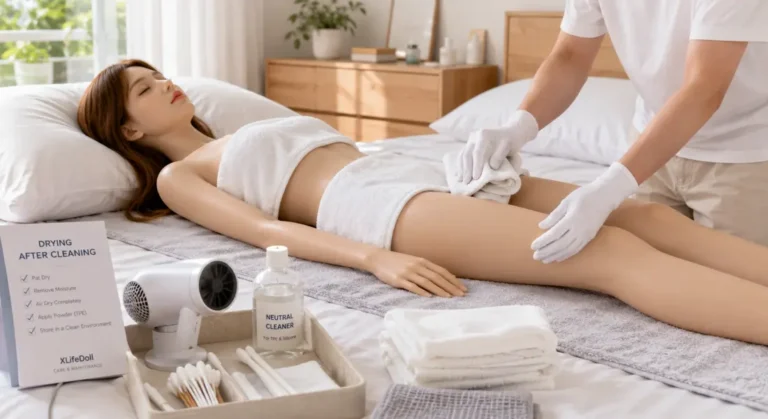
Cleaning and Drying Differences
Cleaning should never be treated as a material-only issue.
A full-size doll also contains:
- a skeleton;
- joints;
- structural components;
- connectors;
- possibly electronic systems.
WM DOLL recommends cleaning its TPE surface with:
- a soft wet cloth;
- mild antibacterial soap;
- a moderate amount of water;
followed by gentle towel drying.
The manufacturer specifically warns against fully submerging the product because water entering the internal structure can contribute to skeleton corrosion and internal mold growth.
This creates a critical distinction:
A material surface may tolerate cleaning with water without the entire assembled product being safe to submerge.
For a complete procedure, link to:
Powder and Surface Care
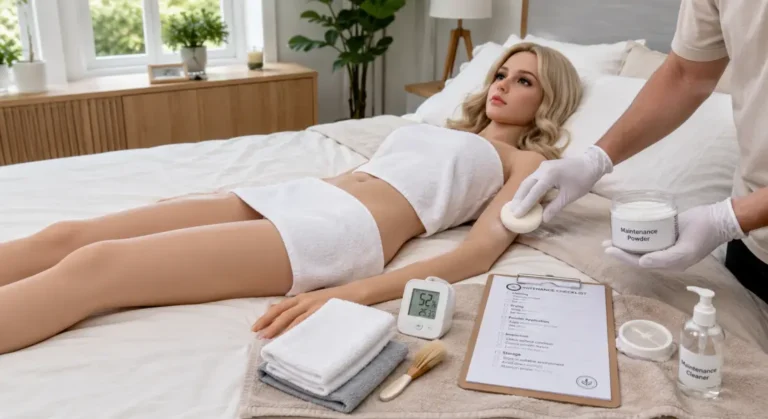
For documented WM DOLL TPE products, the manufacturer recommends applying Renewal Powder after the doll is completely dry.
The stated purpose is to:
- reduce tackiness;
- restore a softer, velvety surface feel.
That is useful evidence—but it should not be converted into:
“Every TPE doll needs baby powder on a fixed schedule.”
The correct rule is:
Use material-specific aftercare that is supported by the manufacturer for the actual product.
For detailed instructions, link to:
How to Apply Maintenance Powder to a TPE Sex Doll
Lubricant Compatibility
Lubricant choice is also a material compatibility issue.
For the WM DOLL TPE products covered by the current manual, the manufacturer specifies:
water-based lubricant only
and warns that silicone-based or petroleum-based oils can break down the TPE material.
That is strong product-family evidence.
However, it should not be expanded into:
“Every TPE formulation from every manufacturer uses the exact same lubricant rule.”
The more reliable ownership principle is:
Check the lubricant compatibility requirements for the specific doll material and product system.
For a full comparison, link to:
What Lubricant Is Safe for a Sex Doll?
Storage Differences
Storage is one of the areas where material behavior becomes especially practical.
For documented TPE products, current manufacturer evidence highlights:
- prolonged pressure;
- deep flexion;
- surface contact;
- UV exposure;
- oil transfer;
- material folding
as issues that should be managed carefully.
This does not justify inventing universal temperature or humidity thresholds.
For example, we do not use unsupported fixed rules such as:
- exactly 18–22°C;
- exactly 40–60% humidity;
- TPE fails above 25°C;
- silicone becomes brittle below 15°C.
Those values were part of older content but are not adequately supported by the current manufacturer evidence base.
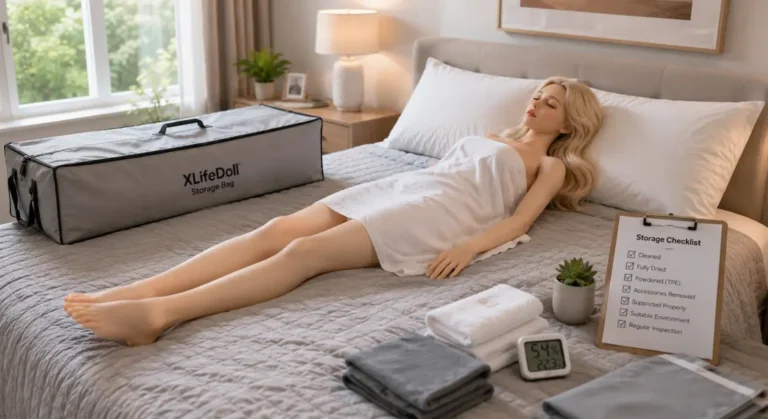
A better general rule is:
Store the doll in a clean, dry, protected environment that minimizes prolonged pressure, direct sunlight, excessive heat, and unsuitable surface contact.
Then follow the model-specific instructions for the exact product.
Which Is Better: TPE or Silicone?
There is no responsible universal answer.
A useful purchase decision should consider more than the material label.
Consider a TPE model if:
the specific product offers the softness, flexibility, body design, weight, and feature set you want—and you are comfortable following its TPE-specific care requirements.
Consider a silicone model if:
the specific product offers the body construction, firmness, finish, features, and manufacturer-documented properties that better match your preferences.
The key phrase is:
specific product
not:
material category alone
A high-quality TPE model and a low-quality TPE model are not identical simply because both use TPE.
The same applies to silicone.
How to Choose Based on Ownership Needs
Instead of asking:
“Which material is better?”
use this sequence.
1. Decide what matters most to you
Examples:
- softness;
- body firmness;
- weight;
- posing;
- maintenance effort;
- storage space;
- cleaning routine.
2. Compare the exact product construction
Check:
- material specification;
- body weight;
- skeleton;
- standing option;
- lightweight construction;
- soft-body options;
- removable components.
3. Read the manufacturer care instructions
A product that looks appealing but requires a maintenance routine you are unlikely to follow may not be the best ownership fit.
4. Compare actual ownership requirements
Ask:
- How should it be stored?
- Does it require powder?
- Which lubricant is compatible?
- What cleaning restrictions apply?
- How sensitive is it to clothing or surface contact?
- Are there movement limits?
5. Choose the model—not just the material label
This is the most important buying principle in the article.
Choose the specific doll first, then evaluate whether its material system and maintenance requirements fit your ownership needs.
Related Care & Maintenance Guides
This article should function as a material foundation node, so the bottom of the page should distribute users into more specific guides.
Recommended internal links:
- How to Clean a Sex Doll Safely
- How to Dry a Sex Doll Properly After Cleaning
- How to Store a Sex Doll Safely
- How to Apply Maintenance Powder to a TPE Sex Doll
- Why You Should Never Use a Hair Dryer on a TPE Sex Doll
- What Lubricant Is Safe for a Sex Doll?
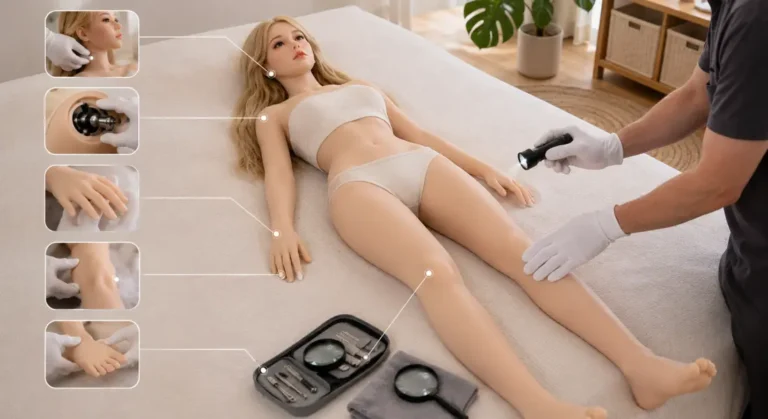
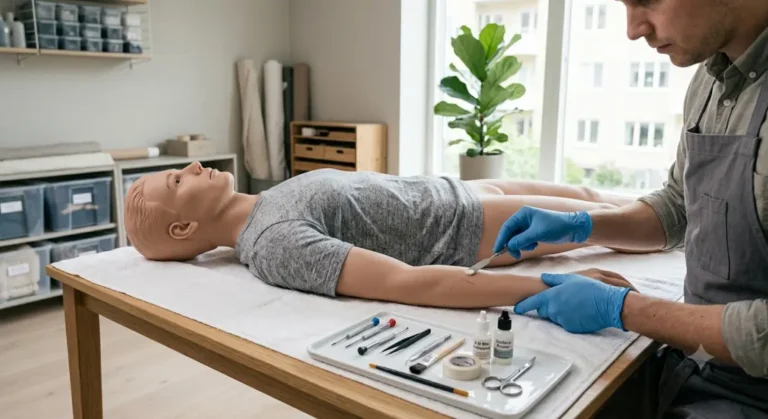
- How to Inspect a Sex Doll for Damage
- What to Do After Receiving a Sex Doll
Commercial links should remain separate:
Shop by Material
Conclusion
The most useful way to compare silicone vs. TPE sex dolls is not to reduce the decision to simple claims such as:
TPE is softer.
Silicone lasts longer.
Those statements are too broad to describe every model accurately.
The stronger approach is to evaluate:
Material System → Product Construction → Real-World Behavior → Maintenance Requirements → Ownership Fit
Current manufacturer evidence gives us especially detailed information about TPE behavior, including pressure sensitivity, stretching, concentrated heat, UV exposure, dye transfer, oil leaching, cleaning, powder care, storage, and lubricant compatibility.
For silicone products, the same evidence discipline should apply: do not assume a specific grade, hardness, durability level, or chemical property unless it is supported by the manufacturer or technical specification.
For buyers, the practical takeaway is simple:
Do not buy a material label. Buy the specific product whose construction, material specification, care requirements, and ownership experience fit your needs.
Frequently Asked Questions
What is the main difference between TPE and silicone sex dolls?
TPE is a thermoplastic elastomer, while silicone dolls use cured silicone elastomer systems. The different material systems can influence feel, mechanical behavior, maintenance, and storage. Exact properties still depend on the manufacturer formulation and product construction.
Is silicone better than TPE for a sex doll?
Not universally. The better choice depends on the specific product, material formulation, body construction, care requirements, weight, skeleton, and the owner’s preferences.
Is TPE always softer than silicone?
No. Softness depends on formulation, hardness, material thickness, body construction, and other engineering choices. Two products made from the same general material category can still feel different.
Can TPE develop pressure marks or permanent deformation?
Yes, for the WM DOLL TPE products covered by the manufacturer manual, prolonged flexed or seated positions can cause creases and potentially permanent deformation.
Can TPE be damaged by heat?
Concentrated heat can damage documented WM DOLL TPE products. The manufacturer specifically warns against using a hair dryer and recommends only controlled warm—not hot—methods in certain crease-recovery situations.
Can dark clothing stain TPE?
Yes, according to WM DOLL’s TPE care guidance, dark fabrics or patterns may transfer dye into the material, and resulting stains may be difficult to remove.
Do TPE sex dolls need maintenance powder?
The documented WM DOLL maintenance process uses Renewal Powder after complete drying to reduce tackiness and restore surface feel. This should not automatically be treated as a universal rule for every TPE formulation.
What lubricant should I use with a TPE sex doll?
For the WM DOLL TPE products covered by the current manufacturer manual, water-based lubricant is specified. For other products, check the actual manufacturer compatibility guidance before use.