Article Summary
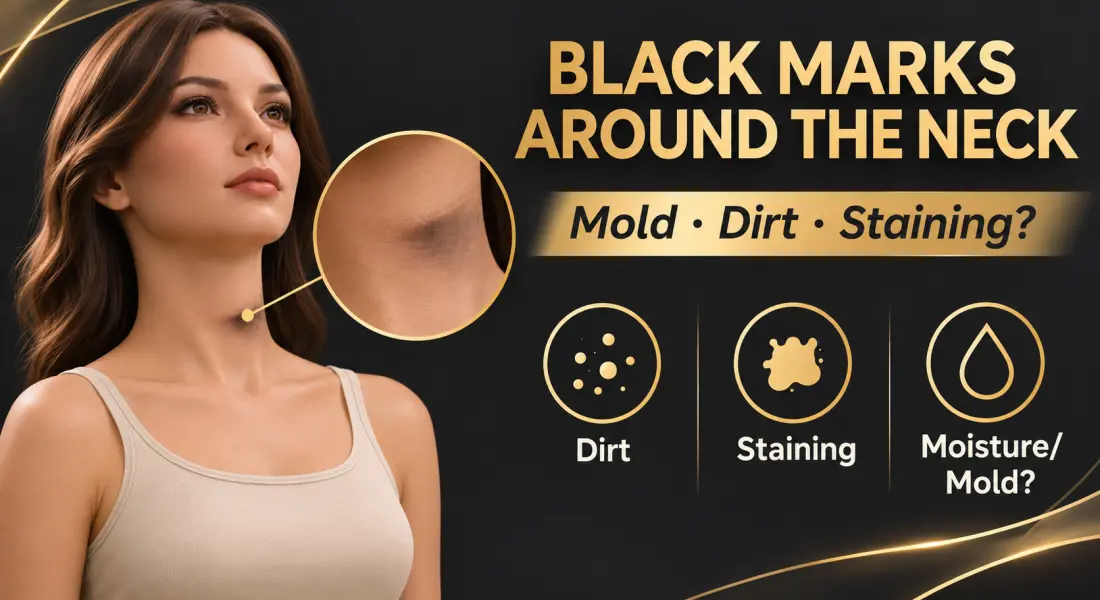
Black marks around a sex doll’s neck do not automatically mean mold. Dirt, transferred color, staining, residue, and moisture-related contamination can look similar. Inspect the area first before deciding how it should be cleaned.
Quick Answer
A black or dark mark around a sex doll’s neck cannot be identified as mold by color alone.
First check whether the area is dry or damp, whether loose residue can be removed gently, whether the discoloration appears to be within the material, and whether the mark extends into the neck opening or another inaccessible area.
Manufacturer guidance confirms that internal moisture should be avoided and that dark materials can stain some doll surfaces. However, neither a black color nor an unusual odor by itself proves that mold is present.
On This Page
- What Can Black Marks Around a Sex Doll’s Neck Mean?
- Can You Identify Mold on a Sex Doll by Color Alone?
- Why Can the Neck Area of a Sex Doll Develop Dark Marks?
- How Should You Inspect Black Marks Around a Sex Doll’s Neck?
- How Can You Tell Surface Dirt From Staining on a Sex Doll?
- What Signs Increase Concern About Moisture or Mold in a Sex Doll?
- What Should You Do First if You Find a Black Mark on a Sex Doll?
- Which Cleaning Products Should You Avoid on Suspected Mold or Black Marks?
- How Important Is Complete Drying After Cleaning a Sex Doll?
- When Should You Stop DIY Cleaning and Contact Support?
- How Can You Reduce the Risk of Future Neck-Area Contamination?
- Frequently Asked Questions
What Can Black Marks Around a Sex Doll’s Neck Mean?
Black or dark marks around a sex doll’s neck can have several possible explanations. They may be surface dirt, residue, transferred pigment, staining, material discoloration, moisture-related contamination, or suspected mold.
The appearance of the mark alone is not enough to determine the cause.
A useful first distinction is between:
- material sitting on the surface;
- color that appears to have transferred into the doll material;
- visible moisture or dampness;
- discoloration inside the neck opening;
- a mark that repeatedly returns after cleaning.
These observations can help narrow the possibilities, but they still do not provide a laboratory diagnosis.
The safest approach is to treat the mark first as an unidentified condition, not as confirmed mold.
Can You Identify Mold on a Sex Doll by Color Alone?
No. A black, gray, brown, or dark-colored mark does not by itself prove that mold is present.
Different problems can look similar.
For example:
- surface residue can appear dark;
- dust or lint can collect in hidden areas;
- dark fabrics can transfer pigment;
- material staining can remain after surface cleaning;
- moisture-related contamination can produce visible changes.
Because these conditions can overlap visually, color alone is not a reliable diagnostic test.
An unusual smell also does not independently confirm mold.
Odor can be associated with many different factors, including the material itself, cleaning residue, storage conditions, or contamination.
A better question is:
What additional evidence is present besides the color?
Why Can the Neck Area of a Sex Doll Develop Dark Marks?
The neck area can develop visible marks because it is partly hidden when the head is attached and may involve several contact surfaces.
Depending on the doll design, this area can include:
- the neck surface;
- the head base;
- the connector;
- the neck opening;
- surrounding shoulder material;
- contact with a wig or other dark material.
Because the area may not be visible during routine use, residue or discoloration may not be noticed until the head is removed.
Moisture exposure is another factor worth checking.
Some manufacturer cleaning instructions specifically recommend protecting the neck connector from water during cleaning. Manufacturer documentation also warns against allowing water to enter internal structures.
However, moisture exposure should be treated as a risk factor, not proof that a specific dark mark is mold.
Although this guide focuses on the neck because that is where the visible mark was observed, moisture-related contamination is not limited to this area. Internal channels, recessed cavities, connectors, and other areas that are difficult to dry can also require inspection if moisture has entered or remained trapped.
How Should You Inspect Black Marks Around a Sex Doll’s Neck?
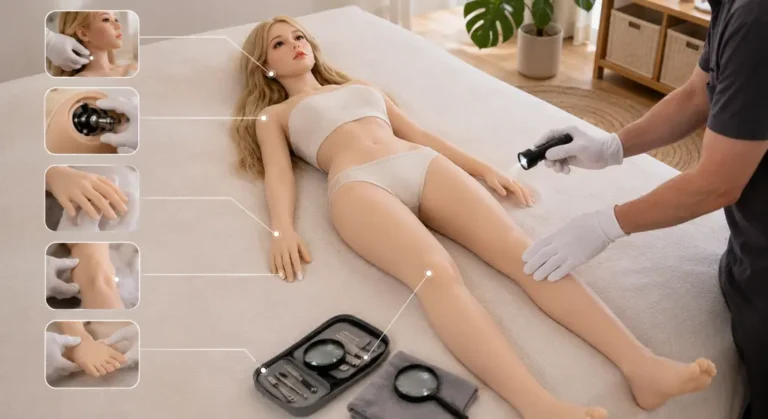
Inspect the area before applying a cleaner or attempting aggressive removal.
1. Remove the head only if the design allows it
Follow the product’s normal head-removal procedure.
Do not force a connector or disassemble internal parts that are not designed for user removal.
2. Check whether the area is dry or damp
Look and feel carefully around accessible surfaces.
Visible moisture or dampness deserves additional attention because internal moisture should not remain trapped in the doll.
3. Examine where the mark is located
Determine whether it is:
- only on the exposed surface;
- around the connector;
- inside the neck opening;
- underneath a contact surface;
- extending into an inaccessible internal area.
4. Look at the character of the mark
Observe whether it appears to be:
- loose residue;
- a flat color change;
- transferred pigment;
- irregular material on the surface;
- a recurring mark after previous cleaning.
Do not scrape or cut into the material to investigate it.
5. Photograph the area
Take:
- one wider photo showing the neck area;
- several close-up photos;
- photos of the connector and neck opening if visible.
These images can be useful if manufacturer or retailer support is needed.
How Can You Tell Surface Dirt From Staining on a Sex Doll?
A gentle surface check may help distinguish removable residue from color that has transferred into the material, but it cannot confirm the biological cause of a mark.
If a dark mark reduces or disappears with an approved gentle cleaning method, superficial residue may have been present.
If the surface becomes clean but the dark color remains within the material, staining or discoloration may be more likely.
This distinction is particularly relevant when the area has been in contact with:
- dark fabrics;
- dark wig caps;
- strongly dyed clothing;
- other colored materials.
Multiple manufacturer care instructions warn that dark materials can stain some doll surfaces.
However:
A stain that does not wipe away is not automatically mold.
Likewise:
A mark that wipes away is not automatically harmless dirt.
The observation helps narrow the issue, but it does not independently identify its cause.
Observation Guide
| Observation | Possible Explanation | What It Does Not Prove |
|---|---|---|
| Dry dark residue wipes away gently | Surface dirt or residue may be present | Does not prove or rule out mold |
| Dark color remains after gentle cleaning | Staining or discoloration may be present | Does not prove mold |
| Neck area is visibly damp | Moisture exposure is present | Does not prove mold |
| Dark material is visible inside an inaccessible opening | Internal contamination may be possible | Cause cannot be identified visually |
| Unusual odor appears with visible changes | Further inspection is appropriate | Odor alone does not prove mold |
| Mark repeatedly returns after cleaning | Underlying cause may remain | Requires further assessment |
What Signs Increase Concern About Moisture or Mold in a Sex Doll?
Concern should increase when several warning signs occur together rather than when only a dark color is present.
Examples include:
- persistent dampness;
- evidence that water entered the neck opening or body;
- visible changes in an internal or inaccessible area;
- recurring dark material after appropriate surface cleaning;
- worsening discoloration;
- unusual odor together with visible contamination;
- signs of moisture near metal or internal structures.
Manufacturer documentation specifically warns that water entering internal structures can contribute to corrosion and internal mold growth.
This makes retained internal moisture a legitimate maintenance concern.
It does not, however, mean that every dark area near a connector is mold.
What Should You Do First if You Find a Black Mark on a Sex Doll?
Use a conservative troubleshooting sequence rather than immediately applying a strong disinfectant.
Stop using the doll temporarily
If the nature of the contamination is uncertain, pause use until the area has been inspected.
Document the condition
Take photos before cleaning.
This provides a useful comparison and can help support identify whether the condition changes.
Confirm the doll material
Determine whether the affected part is:
- TPE;
- silicone;
- another manufacturer-specific material.
Do not assume that a cleaner approved for one material is safe for another.
Check the manufacturer’s cleaning instructions
Use the cleaning method specified for that product or material whenever possible.
Clean only accessible surface contamination gently
If the manufacturer permits gentle surface cleaning, remove loose surface residue without aggressive rubbing or scraping.
Prevent additional water from entering the neck opening
Avoid flooding the connector or internal cavity during cleaning.
Dry the area completely
Do not reassemble or store the doll while accessible areas remain damp.
Reinspect the area
Check whether the mark:
- disappeared;
- remained unchanged;
- appears embedded in the material;
- returned after cleaning;
- extends into an inaccessible area.
If the cause remains unclear, stop escalating the cleaning process and contact support.
Which Cleaning Products Should You Avoid on Suspected Mold or Black Marks?
Do not automatically reach for aggressive household mold-removal products simply because a mark appears black.
Manufacturer guidance for doll materials commonly emphasizes mild, compatible cleaners and warns against harsh or corrosive chemicals.
Do not assume that the following products are universally safe:
- bleach;
- chlorine-based mold cleaners;
- acetone;
- strong solvents;
- concentrated alcohol;
- hydrogen peroxide;
- household disinfectants;
- abrasive powders.
Some may damage:
- TPE;
- silicone surfaces;
- makeup;
- pigments;
- coatings;
- adhesives.
The correct cleaning chemistry depends on the manufacturer and material.
A strong cleaner that removes a dark mark may also permanently alter the surface.
How Important Is Complete Drying After Cleaning a Sex Doll?
Complete drying is one of the most consistent principles in manufacturer care documentation.
Cleaning should not be treated as complete while moisture remains trapped in or around the product.
Manufacturer guidance supports several related principles:
- pat surfaces dry gently;
- keep internal areas dry;
- use appropriate drying tools where specified;
- avoid prolonged soaking;
- prevent water from entering internal structures;
- store the doll only after relevant areas are dry.
This distinction is especially important around:
- neck openings;
- internal channels;
- connectors;
- recessed areas;
- other locations where moisture may be difficult to see.
For a detailed drying procedure, see How to Dry a Sex Doll Properly After Cleaning.
When Should You Stop DIY Cleaning and Contact Support?
Stop DIY troubleshooting when the problem is no longer limited to an accessible surface.
Contact the retailer or manufacturer if:
- the dark material appears inside the body;
- contamination is visible below the surface;
- the neck opening cannot be inspected safely;
- water may have entered an internal cavity;
- the mark keeps returning;
- the affected area is becoming larger;
- the surface begins to crack or tear;
- you already used an unknown or aggressive chemical;
- the material has changed texture;
- manufacturer instructions do not explain the condition.
When contacting support, provide:
- manufacturer;
- model;
- material;
- order information;
- when the issue was first noticed;
- whether the area was wet;
- what cleaning products have already been used;
- clear photos and video where useful.
Internal contamination should not be treated as a reason to cut open or modify the doll unless the manufacturer specifically instructs you to do so.
How Can You Reduce the Risk of Future Neck-Area Contamination?
Prevention should focus on moisture control, compatible materials, and routine inspection.
Useful practices include:
- prevent unnecessary water from entering the neck opening;
- protect connectors during cleaning when the manufacturer instructs you to do so;
- dry the neck area completely before reinstalling the head;
- inspect hidden contact areas periodically;
- avoid prolonged contact with strongly dyed materials where staining is possible;
- keep the doll dry before storage;
- follow the cleaning instructions for the specific material and manufacturer.
There is no evidence-based universal inspection interval for every doll.
A practical time to check the neck area is when the head is already being removed for normal maintenance or inspection.
Related XLifeDoll Guides
How to Inspect a Sex Doll for Damage?
Use a structured inspection process to check the body, joints, surface, connectors, and other areas for changes before they become larger problems.
How to Clean a Sex Doll Safely?
Follow material-appropriate cleaning methods instead of using aggressive household chemicals.
How to Dry a Sex Doll Properly After Cleaning?
Learn why surface drying and internal drying should be treated as separate maintenance tasks.
How to Prevent Sex Doll Stains?
Understand how dark fabrics and strongly dyed materials can transfer color to some doll surfaces.
How to Prevent Surface Damage to a Sex Doll?
Learn how friction, pressure, incompatible products, and improper handling can affect doll surfaces.
Frequently Asked Questions
Is every black mark on a sex doll mold?
No. A black mark may be dirt, residue, transferred pigment, staining, discoloration, moisture-related contamination, or suspected mold. Color alone cannot confirm the cause.
Can black staining around a sex doll’s neck be caused by dirt?
Surface dirt or residue is one possible explanation. If the mark can be removed gently with an approved cleaning method, superficial contamination may have been present. This does not identify the exact cause.
Can moisture cause mold inside a sex doll?
Manufacturer documentation warns that retained water inside some doll structures can promote internal mold growth and corrosion. This establishes internal moisture as a risk factor, but does not mean every damp or dark area is mold.
Should I use bleach to remove suspected mold from a sex doll?
Do not use bleach or another aggressive household mold cleaner unless the manufacturer specifically confirms compatibility with that product and material. Strong chemicals may damage the doll surface.
What should I do if the black mark is inside the neck opening?
Avoid aggressive cleaning or disassembly. Document the area, keep it dry, and contact the retailer or manufacturer if the affected location cannot be safely accessed or identified.
Can a dark wig or clothing cause black marks on a sex doll?
Dark or strongly dyed materials can stain some doll surfaces. Manufacturer documentation repeatedly warns about dye transfer from dark materials.
Does a bad smell prove that a sex doll has mold?
No. Odor alone is not enough to confirm mold. It should be considered together with visible changes, moisture history, and the location of the problem.
Should I keep using the doll while investigating a black mark?
If contamination is uncertain, temporarily stop use until the area has been inspected, appropriately cleaned where possible, and fully dried.
Conclusion
A black mark around a sex doll’s neck should be treated as a symptom to investigate, not an automatic mold diagnosis.
The most useful sequence is:
observe → inspect → identify the material → clean conservatively → dry completely → reinspect → escalate if uncertain
Surface dirt, staining, transferred pigment, moisture-related contamination, and mold can sometimes appear similar without further evidence.
Manufacturer documentation gives us two particularly reliable principles:
- Keep water out of internal structures whenever possible.
- Make sure cleaned areas are fully dry before reassembly or storage.
If the dark area is internal, persistent, inaccessible, or repeatedly returns after appropriate cleaning, further DIY treatment is unlikely to provide a reliable diagnosis. At that point, manufacturer or retailer support is the appropriate next step.